Pre-IPO SPV vs Direct Share Ownership 2026: Fees, Rights & Exit
Quick Answer
When evaluating a Pre-IPO investment, choosing the company is only the first question. A more fundamental question is: what do you actually own after the transaction closes?
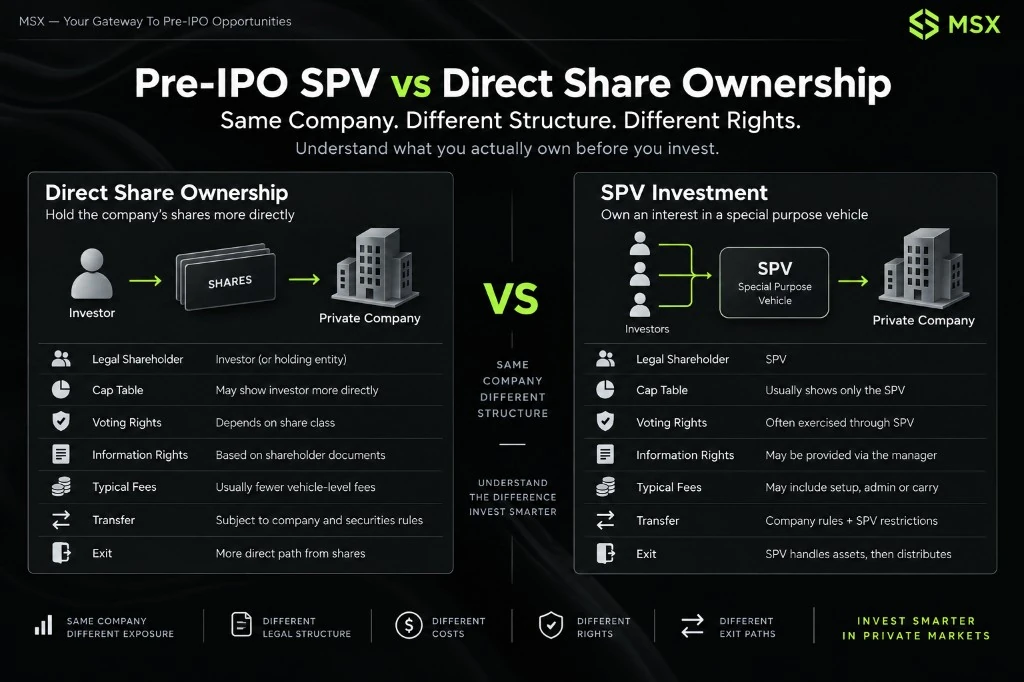
With direct share ownership, an investor generally holds the private company's shares through a more direct ownership chain. In an SPV structure, a separate special purpose vehicle usually holds the underlying company shares, while investors own interests in that SPV.
Both structures can provide economic exposure to the same private company, but they may differ materially in legal ownership, voting rights, information rights, fees, transfer restrictions and the way proceeds are distributed at exit.
Within the broader Pre-IPO investing framework, ownership structure should be checked before the company story:
Eligibility → Structure → Price & Fees → Transfer Rules → Exit → Company Thesis
This guide focuses on the Structure step: how investing through an SPV differs from more direct ownership of private-company shares.
| Key Question | Direct Shares | SPV | |---|---|---| | Who holds the company shares? | Investor or a more direct holding structure | SPV entity | | What does the investor own? | Company-share interest | Interest in the SPV | | Cap table | Investor or holding entity may appear more directly | Usually the SPV appears as one holder | | Voting rights | Depend on share class and agreements | Often governed through the SPV | | Information rights | Depend on shareholder documents | May be received through the SPV manager | | Fees | Usually fewer vehicle-level fees | May include setup, administration or carry | | Transfers | Subject to company and securities restrictions | May face both company and SPV restrictions | | Exit | More direct path from underlying shares | SPV generally receives and distributes proceeds |
> Risk note: This article is for educational and informational purposes only and is not investment or legal advice. Actual investor rights depend on subscription agreements, SPV operating agreements, shareholder agreements, corporate documents and other transaction materials.
What Does “Direct Ownership” of Pre-IPO Shares Actually Mean?
“Direct share ownership” sounds straightforward, but private-market ownership can still involve intermediaries.
An investor's personal name may not necessarily appear directly on the target company's cap table. The structure may involve a nominee, custodian, broker, transfer agent or another holding arrangement.
So the label “direct shares” is not enough by itself.
Investors should verify:
- whether they are buying shares of the target company or an interest in another entity;
- who the registered shareholder is;
- whether they are treated as a beneficial owner;
- which class of shares is being acquired;
- who exercises voting and information rights;
- whether and how the position can be transferred.
Two investment opportunities referencing the same private company can therefore place investors in very different legal positions.
That is also one of the main reasons Pre-IPO companies and public stocks should not be evaluated in exactly the same way. Public shares typically operate within more standardized disclosure, trading and settlement systems, while private securities can involve tighter transfer restrictions, lower liquidity and less standardized access to company information.
What Is a Pre-IPO SPV?
SPV stands for Special Purpose Vehicle.
In a Pre-IPO transaction, an SPV is typically a separate legal entity created to hold shares in a specific private company or a limited group of investments.
A simplified structure looks like this:
``text Investor A ─┐ Investor B ─┼── SPV ──→ Private Company Shares Investor C ─┘ ``
Instead of placing dozens or hundreds of smaller investors directly onto the private company's cap table, the company may see only one shareholder:
the SPV.
The SPV then records the participating investors' interests internally.
This structure can centralize:
- ownership of the underlying shares;
- document execution;
- voting arrangements;
- administration;
- distributions;
- exit processing.
That can make a transaction easier to administer, especially when many smaller investors are participating.
But one distinction should remain clear:
> Owning an interest in an SPV is not necessarily the same legal position as directly owning the underlying company's shares.
The rights of an SPV investor are determined by the vehicle's governing documents and the specific transaction agreements.
SPV vs Direct Shares: What Are the Key Differences?
The most useful way to compare these structures is to separate economic exposure from legal ownership.
| Dimension | Direct Share Ownership | SPV Investment | |---|---|---| | Underlying asset | Private-company shares | SPV holds private-company shares | | Investor owns | More direct company-share interest | SPV membership, partnership or similar interest | | Registered shareholder | Investor or direct holding entity | SPV | | Cap table | Investor or holding entity may appear | SPV generally appears as one holder | | Voting | Defined by share class and agreements | Often exercised through SPV governance | | Information rights | Depend on company agreements | May be routed through the manager | | Administration | More investor-specific | More centralized | | Fee layers | Usually fewer vehicle-level costs | May include additional SPV costs | | Transfer restrictions | Company + securities rules | Company rules + SPV rules | | IPO / acquisition | Shares handled more directly | SPV handles assets before distribution |
Neither structure is automatically better.
An SPV can simplify access and administration. More direct ownership may reduce one legal layer and create a more direct relationship with the underlying shares.
The better question is:
> What rights, costs and restrictions change because of the structure used to obtain the exposure?
Who Is the Legal Shareholder?
This is one of the most important questions in an SPV investment.
A simplified direct structure may look like:
``text Investor ↓ Private Company Shares ↓ Target Company ``
An SPV structure more commonly looks like:
``text Investor ↓ SPV Interest ↓ SPV ↓ Private Company Shares ↓ Target Company ``
In the second structure, the registered shareholder of the target company is generally the SPV rather than every individual investor inside the vehicle.
That can affect:
- who receives official company notices;
- who exercises shareholder votes;
- who handles corporate actions;
- who approves or executes a share sale;
- how IPO or acquisition proceeds move back to investors.
For that reason, a more useful question than:
> “Does this vehicle contain SpaceX, Anduril or Anthropic shares?”
is:
> “What legal asset will I own after I sign the transaction documents?”
What Rights Do SPV Investors Actually Receive?
The word “SPV” does not automatically mean an investor has no rights.
Likewise, “direct shares” does not automatically mean an investor receives full voting or information rights.
Actual rights can depend on several layers of documentation, including:
- the underlying share class;
- shareholder agreements;
- subscription agreements;
- the SPV operating agreement;
- side letters;
- company charter documents;
- manager or general-partner authority.
Voting Rights
If an investor directly holds shares carrying voting rights, that investor may have a more direct route to participating in certain shareholder matters.
Inside an SPV, however, voting on the underlying shares may be exercised by the SPV manager or general partner.
That does not mean every SPV works the same way. The governing documents determine how much influence individual investors actually have.
Information Rights
Private companies generally do not provide the same standardized public disclosure that listed companies do.
A direct shareholder's access to information depends on the rights attached to the shares and the relevant agreements.
SPV investors may instead depend on the manager to obtain and distribute company information.
Dividends and Other Distributions
If the underlying private company makes a cash distribution, SPV investors may not receive it directly from the company.
A typical path may look more like:
``text Target Company ↓ SPV ↓ Applicable fees / obligations ↓ SPV Investors ``
The timing and treatment of distributions again depend on the governing documents.
How Do SPV Fees Affect Investment Returns?
One of the clearest structural differences is that an SPV may add another layer of costs.
Possible charges can include:
- transaction or setup fees;
- legal and administrative costs;
- ongoing management fees;
- custody or reporting expenses;
- carried interest or performance allocations.
There is no universal SPV fee structure.
Different vehicles can use very different economics, so investors should not assume that every SPV charges the same management fee or carry.
Consider a purely illustrative example:
```text Initial investment: $10,000
One-time structure / administration cost: 2% Amount entering the investment structure: $9,800
Exit value: $15,000
Gain: $15,000 - $9,800 = $5,200
If the agreement applies 10% carry to the gain: $5,200 × 10% = $520 ```
Other applicable costs could still affect the final distribution.
> This example is illustrative only. It does not represent any specific SPV, MSX product or market-standard fee schedule.
Two vehicles may hold shares in the same company and still produce different investor outcomes because of entry price, setup fees, ongoing costs, carry and exit charges.
So comparing Pre-IPO opportunities requires looking beyond the company name.
Does an SPV Make a Pre-IPO Investment More Liquid?
Not automatically.
SPV ≠ liquidity.
Private-market securities can already be subject to significant transfer restrictions.
With more direct ownership, investors may face:
- company approval requirements;
- rights of first refusal;
- shareholder-agreement restrictions;
- securities-law restrictions;
- limits on eligible buyers.
An SPV can introduce another layer:
``text Restrictions on the underlying company shares + Restrictions on the SPV interest ``
That means “Can I sell?” may actually involve two separate questions:
> Can the SPV sell the underlying company shares?
and:
> Can I transfer my own interest in the SPV?
These are not necessarily the same transaction.
This distinction is especially important because a platform may show a valuation or reference price even when the investor cannot freely transfer the position at that price.
What Happens at IPO, Acquisition or Secondary Sale?
Exit mechanics are one of the most important reasons to understand the ownership structure before investing.
Scenario 1: The Company Goes Public
A direct shareholder's private shares may eventually convert into or become associated with listed shares, subject to the applicable transaction structure.
That does not mean the investor can necessarily sell immediately after the IPO.
There may still be:
- lock-up restrictions;
- restrictive legends;
- registration requirements;
- company or underwriting arrangements;
- applicable securities rules.
The exact restrictions depend on the specific transaction.
An SPV can create more possibilities.
For example:
``text SPV continues to hold the listed shares ``
or:
``text SPV distributes shares to investors ``
or:
``text SPV sells the shares ↓ Distributes cash ``
The SPV documents should explain what authority the manager has in these situations.
Scenario 2: The Company Is Acquired
With more direct ownership, the shareholder generally receives consideration according to the acquisition terms.
In an SPV structure, the process may look more like:
``text Acquirer ↓ Pays consideration to SPV ↓ SPV handles fees / taxes / obligations ↓ Distributes proceeds to investors ``
That can create an additional settlement step even after the underlying company transaction has closed.
Scenario 3: Secondary Sale
With direct ownership, a secondary transaction usually involves selling the underlying private-company shares.
Inside an SPV structure, two different types of transactions may be possible:
- the SPV sells the underlying shares;
- the investor transfers the SPV interest.
Whether either route is permitted depends on the applicable documents and restrictions.
When Might an SPV Structure Make More Sense?
The reason to use an SPV is not that it automatically generates higher returns.
Its main value is usually structural.
An SPV may be useful when:
- the private company does not want a large number of small shareholders;
- an individual investor cannot meet the threshold for a direct allocation;
- a platform needs to aggregate multiple investors into one transaction;
- investors care more about economic exposure than direct governance;
- centralized administration makes documentation and exit handling easier.
In these situations, the extra entity may be what makes access possible in the first place.
When Might More Direct Ownership Be Preferable?
More direct ownership may deserve closer consideration when an investor places greater value on:
- a more direct legal relationship with the underlying shares;
- clearer visibility into shareholder rights;
- fewer vehicle layers;
- a simpler fee structure;
- more direct visibility into transfers and corporate actions.
But another misconception should be avoided:
> Direct ownership does not automatically mean high liquidity.
Private-company shares can remain difficult to sell even when they are held through a relatively direct structure.
The absence of an SPV does not remove company-level transfer restrictions, securities rules or the lack of an active market.
Is an SPV the Same as Equity Crowdfunding?
No.
An SPV describes a legal holding and investor-aggregation structure.
Equity crowdfunding is more closely related to a capital-raising and investor-access method.
A crowdfunding offering may use different ownership structures, while an SPV can also be used in transactions that have nothing to do with crowdfunding.
That is why Pre-IPO shares and equity crowdfunding should not be treated as interchangeable concepts. They may target similar investors, but the access route, transaction structure, underlying assets and investor rights can differ.
What Should You Ask Before Investing Through a Pre-IPO SPV?
Instead of starting with “How popular is this company?”, investors can begin with ten more practical questions:
- [ ] Am I buying shares of the target company or an SPV interest?
- [ ] Who is the registered shareholder?
- [ ] What class of underlying shares does the vehicle hold?
- [ ] Who controls voting rights?
- [ ] What information rights do I receive?
- [ ] What fees apply at entry, during ownership and at exit?
- [ ] Does carried interest apply?
- [ ] What transfer restrictions apply to both the shares and my SPV interest?
- [ ] What happens if the company completes an IPO?
- [ ] How and when are proceeds distributed after a sale or acquisition?
If the transaction documents do not answer these questions clearly, the popularity of the underlying company should not be treated as a substitute.
Where Does SPV Structure Fit Into a Pre-IPO Investment Workflow?
Investors often start with questions such as:
> What is SpaceX worth? > When will Anduril go public? > What could Anthropic's next valuation be?
But before an order is placed, the sequence should usually start earlier.
``text Am I eligible? ↓ What structure am I buying? ↓ What is the entry price and total cost? ↓ Can the position be transferred? ↓ How does exit work? ↓ Only then evaluate whether the company thesis justifies the price and risk ``
In other words:
Company research cannot replace structure research.
Once the ownership structure, fees and investor rights are understood, operational questions such as account setup, project review, subscription, order handling and settlement become the next step. Those execution issues belong in the Pre-IPO account, order and settlement workflow, rather than being mixed into the SPV-versus-direct-ownership comparison.
What to Read Next
Once the structure is understood, company-specific cases become more useful.
The Anduril Pre-IPO guide applies many of these questions to a single private company, including access, valuation and exit considerations.
The Starlink Pre-IPO guide provides another company-level example where investors need to distinguish the underlying business story from the actual structure through which exposure may be offered.
Final Takeaway
The most important difference between an SPV and direct share ownership is not which structure sounds more sophisticated.
It is:
> How many legal layers sit between the investor and the underlying company, and what changes at each layer?
More direct ownership can create a closer relationship with the underlying shares, but it does not automatically guarantee full voting rights, unrestricted information access or liquidity.
An SPV can aggregate multiple investors into a single private-company investment, simplify administration and make some opportunities easier to access. But that extra layer may also introduce additional fees, manager control and transfer restrictions.
So instead of asking:
> “Is an SPV good or bad?”
ask four more precise questions:
What do I actually own?
Who controls it?
What does it cost?
How do I transfer or exit it?
If those questions are not clear, the investor has not yet fully understood the Pre-IPO position.
Official Resources & Methodology
When evaluating a Pre-IPO SPV or direct-share opportunity, legal structure, investor rights, transfer restrictions and distribution mechanics should be verified using the actual transaction documents and applicable regulatory materials.
Useful source types include:
- SEC and Investor.gov materials on private securities;
- FINRA investor education;
- company shareholder documents;
- SPV operating agreements;
- subscription agreements;
- platform disclosures;
- relevant securities-law documentation.
This article uses a comparison framework rather than assuming that every SPV or direct-share transaction follows the same terms.
Full Disclaimer: This material is for educational and informational purposes only and does not constitute investment, legal, tax or financial advice. Pre-IPO investments can involve high risk, limited liquidity, restricted transfers and limited disclosure. Investors can lose all invested capital. Actual ownership rights, fees, transfer arrangements and exit mechanics must be verified through the applicable transaction documents and regulations.