August 26, 2026 | U.S. Market Watch: Inflation and NVIDIA Put the Tech Rally to the Test
U.S. equities finally found a combination that worked for technology stocks on Tuesday: oil prices fell, Treasury yields eased, and semiconductor shares rebounded.
The Dow gained 0.30%, the S&P 500 rose 0.32%, and the Nasdaq Composite added 0.66%. NVIDIA climbed about 2.2%, Micron gained 2.5%, AMD jumped 4.9%, and the Philadelphia Semiconductor Index advanced roughly 1.4%.
Still, the move looked more like position rebuilding ahead of this week’s inflation prints and mega-cap earnings than a full return of the AI trade.
Wednesday brings the real test. At 8:30 a.m. ET, the U.S. will release PCE inflation, the second estimate of second-quarter GDP, and durable goods orders. After the closing bell, NVIDIA will report its quarterly results.
The morning data will help determine how expensive capital should be. NVIDIA’s earnings will tell investors whether AI can generate enough profit to justify current valuations.
Tech Rebounded as Valuation Pressure Eased
The main force behind Tuesday’s technology rally came from outside the stock market.
To choose among compute, networking, and cybersecurity AI themes, start with the AI & US stock themes guide.
For a focused next step, see the US Stocks Weekly.
The 10-year Treasury yield fell to around 4.63%, while the 30-year yield declined to roughly 5.16%. Brent crude also moved back below $90 a barrel. Lower oil prices helped ease inflation concerns, while falling long-term yields reduced the discount-rate pressure on growth stocks.
The economic data behind the bond rally were less encouraging.
U.S. new-home sales fell 10.5% in July to an annualized rate of 607,000. The Conference Board’s Consumer Confidence Index also declined from 90.2 to 89.4 in August. The effect of high borrowing costs on housing and household demand is becoming more visible.
That leaves the market in a delicate position.
Moderately weaker data can support equities by bringing yields down. If the economy cools too quickly, however, investors may move from trading policy relief to pricing in weaker growth.
Tuesday’s rally reflected a temporary balance between those two forces. Wednesday’s data will show whether that balance can hold.
The First Test: Can PCE Keep Yields Moving Lower?
PCE inflation, revised GDP, and durable goods orders will be released at the same time. When the numbers arrive, the first place to look may not be the Nasdaq. It may be the two-year and 10-year Treasury yields.
Three broad outcomes matter:
- Cooler PCE with no major GDP downgrade: The most favorable result for equities. Inflation pressure would be easing without clear evidence that the economy is stalling.
- Hotter PCE with resilient GDP: The most difficult combination for growth stocks. Markets could push expectations for policy easing further out, potentially sending the 10-year yield back above 4.70%.
- Cooler PCE but sharply weaker GDP and durable goods orders: Treasury prices could continue rising, but cyclical and consumer stocks would begin trading on concerns about slower growth.
For technology stocks, the first key question is whether the 10-year yield can remain near the lower end of the 4.60%–4.70% range.
If yields rebound quickly after the data, Tuesday’s technology rally may prove to have been little more than a temporary release of pressure.
The Second Test: Another NVIDIA Beat May Not Be Enough
Macro data will determine the valuation environment. NVIDIA will determine whether the fundamentals of the AI trade remain strong enough to support it—including for readers tracking the name via tokenized exposure under MSX’s AI compute trading rewards.
In the previous quarter, NVIDIA generated $81.6 billion in revenue, including $75.2 billion from its data-center business. The company previously guided for second-quarter revenue of approximately $91 billion, plus or minus 2%.
With expectations already this high, a modest earnings beat may not be enough.
Investors will be watching:
- Growth in data-center revenue and customer orders;
- Delivery progress for Blackwell and subsequent platforms;
- Whether next-quarter revenue guidance is raised again;
- Whether gross margin remains near 75%;
- Whether Microsoft, Meta, Amazon, and other major customers continue expanding AI capital expenditure.
The first move in after-hours trading may not represent the market’s final judgment. Algorithms usually react immediately to headline revenue and earnings. Investors then reassess the stock after reviewing guidance, margins, and management’s comments during the conference call.
The broader semiconductor response may therefore matter more than NVIDIA’s first price move.
If NVIDIA rises alongside AMD, Micron, Broadcom, and data-center stocks, the market may be rebuilding confidence across the wider AI infrastructure chain.
If NVIDIA reports strong results but related stocks fail to participate, capital may still be concentrating in a small number of industry leaders. If NVIDIA itself gives up an initial gain, the market’s concern may have shifted from interest rates to the return on AI investment.
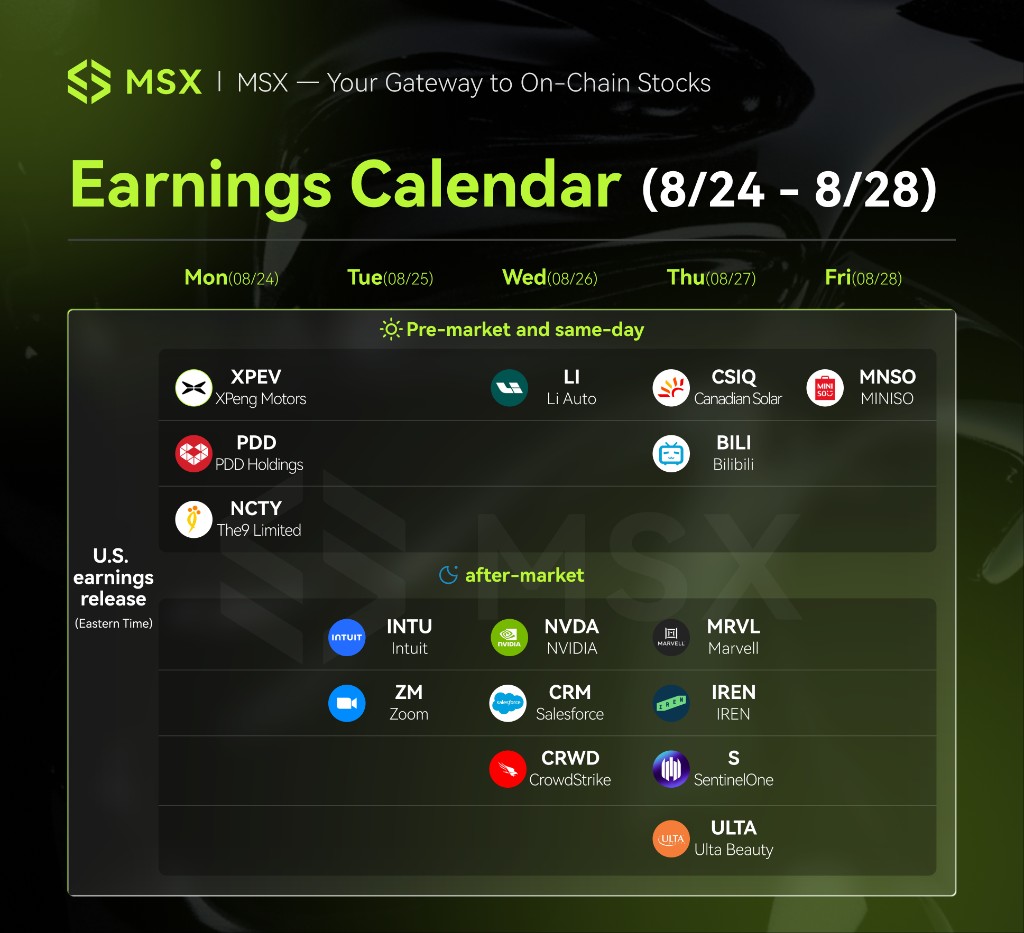
!Earnings Calendar (Aug 24–28, U.S. Eastern Time)
Other Earnings Offer Three Additional Signals
Several other companies are also scheduled to report on Wednesday, but their results are better treated as supporting signals rather than the market’s central story.
Before the opening bell, Li Auto will provide another look at competition in China’s electric vehicle market. Delivery growth alone will not be enough. Vehicle margin and third-quarter guidance will show whether the company is improving demand at the cost of profitability.
After the close, Salesforce will help determine whether enterprise AI is moving from product announcements to contracts and subscription revenue. Agentforce usage, current remaining performance obligations, and organic revenue growth may matter more than quarterly earnings per share.
CrowdStrike, which also reports after the close, will offer a read on enterprise cybersecurity budgets. Net new annual recurring revenue, free cash flow, and full-year guidance will indicate whether corporate spending remains concentrated in mission-critical services.
If NVIDIA, Salesforce, and CrowdStrike all issue strong guidance, the AI rally may broaden from semiconductors into software and cybersecurity.
If only NVIDIA performs well, the market may still be trading infrastructure spending rather than a complete AI earnings cycle.
What to Watch Today
Wednesday’s market can be followed in this order:
- The reaction of two-year and 10-year Treasury yields to the economic data;
- Whether the 10-year yield can remain near 4.60%;
- Whether Brent crude stays below $90 a barrel;
- NVIDIA’s revenue outlook and gross-margin guidance;
- Whether semiconductor, enterprise software, and cybersecurity stocks move together.
The clearest bullish combination would be cooler PCE inflation, another decline in long-term yields, and stronger NVIDIA guidance. That would create the conditions for gains to spread from a few large technology stocks into the wider AI ecosystem.