AI Cybersecurity Stocks 2026: CrowdStrike, Palo Alto, Zscaler, Okta & Cloudflare
Quick Answer
AI investment is expanding beyond GPUs and data centers. As AI agents gain access to enterprise applications, APIs, identity systems, cloud environments, and internal data, the security perimeter is also expanding beyond traditional endpoints and networks into:
To move back upstream into the processing layer of AI infrastructure, see AI Compute Stocks 2026.
> Endpoints → Identity → Networks → Applications → Data → AI Agents
CrowdStrike, Palo Alto Networks, Zscaler, Okta, and Cloudflare each cover different layers of this security stack.
The more useful question is not which company looks the most like an “AI stock,” but which companies can convert the additional security complexity created by AI into sustainable growth in ARR, RPO, platform adoption, and cash flow.
This cybersecurity map sits inside the broader AI & US Stock Themes 2026 framework, alongside compute and networking.
What You'll Learn
This guide explains:
- why AI agents expand the enterprise attack surface;
- where CRWD, PANW, ZS, OKTA, NET, and SentinelOne fit in the security stack;
- how to compare CrowdStrike vs SentinelOne and CrowdStrike vs Zscaler;
- which earnings metrics can help validate the AI security thesis;
- why identity and Zero Trust become more important in the agent era;
- what could break the AI cybersecurity investment thesis;
- how tokenized stocks, stock-linked contracts, and traditional shares differ;
- how to verify product type and risk before taking exposure through MSX.
> Risk note: This article discusses an industry theme and company operating frameworks. It is not a stock recommendation. Stocks, tokenized products, and derivatives can lose value, while leveraged products also involve funding, margin, and liquidation risk.
Why AI Agents Expand the Cybersecurity Attack Surface
Traditional enterprise security models usually assume that most digital activity can ultimately be traced back to:
> a person, a device, or an application.
AI agents make that model more complicated.
An autonomous agent may:
- log in to multiple enterprise applications;
- call APIs;
- access internal data;
- generate and execute code;
- interact with cloud infrastructure;
- trigger business workflows;
- act on behalf of a human user;
- communicate with other agents.
Each additional capability creates another permission boundary.
The security issue created by AI agents is therefore not simply:
> whether hackers will use AI.
The more important change is:
> Enterprises will have a growing number of non-human identities capable of acting autonomously.
That means organizations need to answer questions such as:
- Who is this agent?
- Who created it?
- What data can it access?
- Which APIs can it call?
- Which actions require additional approval?
- How long should its credentials remain valid?
- How can abnormal behavior be detected?
- How can access be revoked immediately?
AI agents therefore increase the importance of several security layers at the same time.
The AI Cybersecurity Stack: What Problem Does Each Company Solve?
The simplest way to understand this investment theme is to break the market into security layers.
| Security Layer | Core Question | Representative Companies | | -------------------------- | ---------------------------------------------------- | ------------------------ | | Endpoint / Workload | What is happening on the device or workload? | CRWD, S | | Identity | Which user or agent is allowed to act? | OKTA | | Zero Trust / Access | Which applications can users and agents access? | ZS, PANW | | Security Platform / SOC | How are threats detected and handled across domains? | PANW, CRWD | | Edge / Application Traffic | What traffic is reaching applications and APIs? | NET | | AI Security | How are models, agents, and AI workloads protected? | Multiple vendors overlap |
!AI cybersecurity stack 2026 mapping CrowdStrike, Palo Alto Networks, Zscaler, Okta and Cloudflare
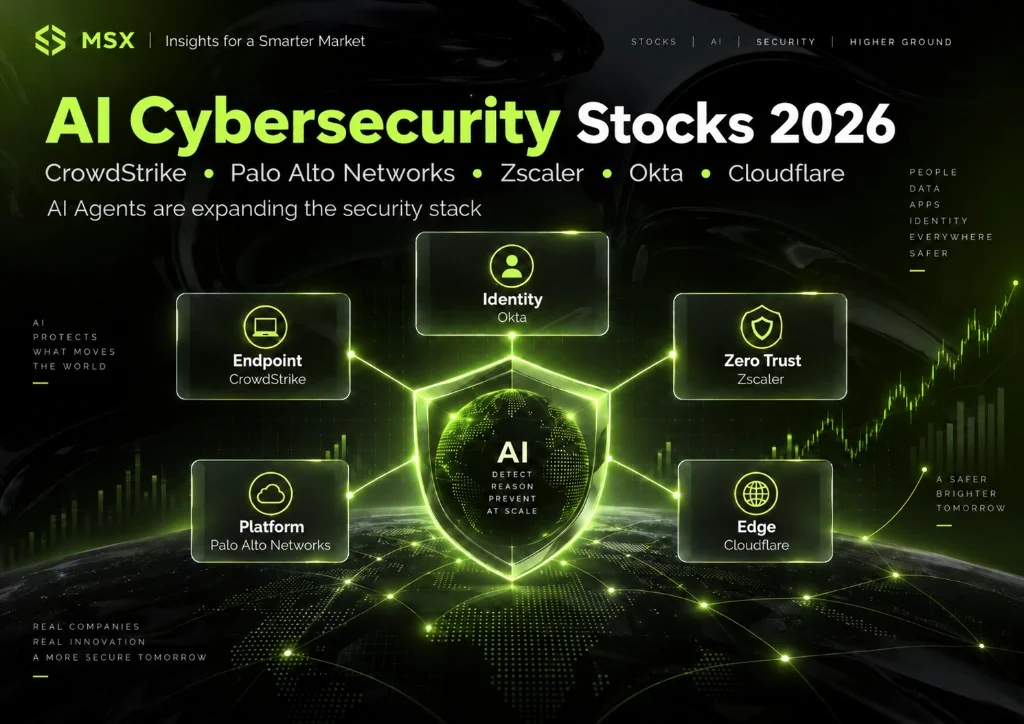
These categories are not hard boundaries.
Cybersecurity companies are increasingly expanding into adjacent markets.
So the shorthand:
> “CRWD is endpoint, ZS is Zero Trust, OKTA is identity”
is still useful for orientation, but it no longer fully describes the competitive landscape in 2026.
The more important trend is:
> Platform Convergence — security platforms are increasingly overlapping.
Enterprises may not want to purchase another standalone tool every time AI creates a new security problem.
Instead, many may prefer:
> to solve more security problems through a smaller number of strategic platforms.
That could become one of the defining competitive dynamics in cybersecurity over the next several years.
Earlier MSX coverage of how the AI trade broadened from compute into security names is available in AI Trade Broadens into Cybersecurity: CRWD & NET.
CrowdStrike: From Endpoint Security to a Broader Security Platform
CrowdStrike was originally most clearly associated with endpoint security.
The Falcon platform now covers a broader range of capabilities, including:
- Endpoint Detection;
- Cloud Security;
- Identity Protection;
- Exposure Management;
- Security Operations.
That means the CRWD investment thesis has evolved from:
> “Enterprises need better endpoint antivirus.”
to:
> “Will enterprises consolidate a larger share of their security budgets onto the Falcon platform?”
One operating metric worth watching closely is:
> Net New ARR
Compared with simple revenue growth, Net New ARR gives a more direct view of current subscription sales momentum.
If AI agents genuinely drive additional security spending, that demand should eventually begin to appear in:
- ARR;
- Net New ARR;
- module adoption;
- large-customer growth;
- retention;
- free cash flow.
For CrowdStrike, the AI narrative therefore needs to be validated through:
> contracts and renewals, not product announcements alone.
SentinelOne: A Smaller Endpoint Challenger
SentinelOne has relatively high business overlap with CrowdStrike.
Both companies cover areas such as:
- Endpoint;
- Workload;
- XDR;
- AI-driven security.
That makes CrowdStrike vs SentinelOne a reasonable search and investment-analysis comparison.
But the comparison should not simply ask:
> Which company talks more convincingly about AI?
A better framework is:
| Metric | Why It Matters | | ------------------- | ----------------------------------------- | | ARR | Measures recurring revenue scale | | Net New ARR | Shows current sales momentum | | Large Customers | Indicates enterprise adoption | | Operating Margin | Measures growth efficiency | | Platform Breadth | Shows expansion potential | | Retention | Measures customer stickiness | | AI Product Adoption | Shows whether AI is creating real revenue |
CrowdStrike currently operates at a larger revenue and platform scale.
Because SentinelOne starts from a smaller base, improved execution could potentially create stronger growth sensitivity.
But the company also faces greater:
- scale risk;
- sales-efficiency risk;
- platform competition risk.
So the more useful question is not:
> Which company is definitely better?
It is:
> How much future growth is already priced into each valuation?
Palo Alto Networks: Platform Consolidation Is the Core Thesis
Palo Alto Networks is one of the broadest security platforms in this group.
Its product portfolio spans:
- Network Security;
- Cloud Security;
- Security Operations;
- AI Security;
- identity-related capabilities.
For PANW, the most important question is therefore not simply:
> How much new cybersecurity demand will AI create?
A more important question is:
> Will that new demand encourage enterprises to consolidate a larger share of security spending onto a single platform?
This is the logic behind:
> Platformization / Security Platform Consolidation
If enterprises increasingly need to protect:
- employees;
- cloud workloads;
- APIs;
- AI models;
- AI agents;
but do not want to manage a dozen different security vendors, broader platforms such as PANW may capture a larger share of the security budget.
Metrics worth following include:
- NGS ARR;
- RPO;
- large platform deals;
- portfolio expansion;
- forward guidance;
- operating margin.
The key point is:
> Do not assume a company becomes an AI winner simply because management mentions AI frequently.
AI-related demand ultimately needs to appear in:
> bookings, ARR, and cash flow.
Zscaler: Zero Trust Extends From Human Users to AI Agents
Zscaler’s core architecture is built around Zero Trust.
A traditional network model generally works like this:
> A user enters the corporate network and then accesses different applications inside it.
Zero Trust emphasizes a different approach:
> After identity and policy checks, the user is connected only to explicitly authorized applications.
AI agents make this model even more important.
An enterprise agent may need to access:
- CRM;
- internal databases;
- cloud storage;
- APIs;
- workflow systems.
What the enterprise does not necessarily want is:
> to place that agent inside the entire corporate network.
Instead, it wants to:
> Allow the agent to connect only to the specific applications required for its task.
That means Zero Trust can evolve from:
> User-to-Application
toward:
> Agent-to-Application
For Zscaler, the important questions in the AI-agent era include:
- Is ARR continuing to grow?
- Are larger platform deals increasing?
- Are agent and workload products gaining adoption?
- Can non-seat-based revenue become more meaningful?
- Are margins improving?
So the question:
> “Is Zscaler a good stock to buy?”
cannot be answered simply by saying that AI agents increase security demand.
Investors still need to evaluate:
> growth, valuation, competition, and profitability.
Okta: Identity Could Become the Control Plane for AI Agents
If an AI agent can perform tasks inside enterprise systems, it needs:
> some form of identity.
Once an identity exists, permissions become necessary.
Enterprises need to determine:
- what the agent can access;
- which actions it can perform;
- which credentials it can use;
- who approved those permissions;
- when permissions should be revoked;
- how abnormal behavior should be detected.
AI agents therefore expand an existing security market:
> Identity and Access Management
That is one of the clearest ways Okta connects to the AI-agent theme.
Historically, identity systems focused on answering:
> “Who is this person?”
Increasingly, they may also need to answer:
> “Who is this agent, who is it acting for, and what is it allowed to do?”
For Okta, one useful framework is:
> cRPO → Product Adoption → Large Customers → Identity Governance → Agent Security Revenue
The real question is not:
> Has Okta launched an agent-related product?
It is:
> Will agent identity ultimately accelerate subscription growth?
Cloudflare: Edge and Traffic Exposure to the Agentic Internet
Cloudflare occupies a very different position from CrowdStrike or SentinelOne.
Its infrastructure sits between:
> Users / Agents → Internet → Applications
As more AI agents:
- call APIs;
- crawl content;
- visit websites;
- communicate with applications;
- generate machine-to-machine requests;
the structure of internet traffic itself may begin to change.
Cloudflare’s opportunity is therefore not only:
> Cybersecurity
but also:
> Network + Edge + Application Security + Developer Infrastructure + Agent Traffic
That is why Cloudflare should not simply be treated as:
> another version of CrowdStrike.
CRWD is closer to endpoint and security operations.
NET is positioned more around:
> internet edge, applications, developers, and traffic control.
For the same reason, a Zscaler vs Cloudflare comparison should not focus only on:
> which company has the better security product.
It should also compare:
- where traffic passes;
- who the customer is;
- the core architecture;
- which layer receives incremental AI-agent traffic.
CrowdStrike vs SentinelOne vs Zscaler: How Should Investors Compare Them?
These companies often appear together in cybersecurity stock screens, but they do not represent identical exposure.
| | CrowdStrike | SentinelOne | Zscaler | | --------------- | ---------------------------- | --------------------- | -------------------------------- | | Historical Core | Endpoint / XDR | Endpoint / XDR | Zero Trust / SSE | | AI Thesis | Endpoint + Security Platform | AI-Native Endpoint | Agent Access + Zero Trust | | Relative Scale | Larger | Smaller | Large cloud security platform | | Key Metric | Net New ARR | ARR + Margin | ARR + Platform Deals | | Core Risk | High growth expectations | Scale and competition | Valuation and platform execution |
CrowdStrike vs SentinelOne
This is closer to:
> direct competition within the same security layer.
The comparison focuses mainly on endpoint, XDR, and platform capability.
CrowdStrike vs Zscaler
This is closer to:
> a comparison across different security layers.
CRWD is expanding outward from endpoint.
ZS is expanding outward from Zero Trust and access.
The two can also integrate with each other.
So:
> The cybersecurity theme does not require one single winner.
AI agents can increase demand across several security layers simultaneously.
What Should Investors Watch in Earnings to Validate the AI Security Thesis?
Cybersecurity stocks can move sharply after earnings.
But if the goal is to test the longer-term AI security thesis:
> Beat or Miss is not the most important question.
Six indicators matter more.
1. ARR and Net New ARR
ARR shows the scale of recurring subscription revenue.
Net New ARR provides a better view of current incremental business momentum.
If a company’s AI security narrative becomes stronger while:
> Net New ARR shows little improvement over time,
investors should question whether the demand is truly converting into orders.
2. RPO and cRPO
These metrics represent contracted revenue expected to be recognized in the future.
They help show whether enterprise customers are willing to sign:
> larger and longer-duration security contracts.
3. Large-Customer Growth
Large-scale AI-agent deployments are more likely to appear first at:
- large enterprises;
- financial institutions;
- technology companies;
- organizations with complex data and compliance requirements.
Large-customer growth is therefore worth monitoring.
4. Platform Adoption
Investors should look at whether customers are:
> buying more modules from the same vendor.
If one enterprise buys:
- Endpoint;
- Identity;
- Cloud;
- SOC;
from a single provider, the platform value is generally greater than that of a standalone point solution.
5. Margin and Free Cash Flow
Revenue growth is not the only objective.
If sales and R&D spending rise even faster as companies compete for AI security demand:
> shareholders may not receive better economic returns.
6. Guidance
Stocks trade on future expectations.
A company can report a strong quarter and still see its stock fall if forward guidance disappoints.
That is why:
> post-earnings divergence between CRWD, OKTA, ZS, or PANW
does not necessarily mean the entire AI cybersecurity thesis has broken down.
Why Agentforce-Like AI Agents Make Identity and Access More Important
Agentforce is more useful here as:
> a demand-side example
than as a Salesforce setup tutorial.
Imagine an agent that can:
- read CRM customer information;
- modify orders;
- send emails;
- call external APIs;
- trigger automated workflows.
That agent effectively has:
> Delegated Authority
Enterprises therefore need controls such as:
- Authentication;
- Least Privilege;
- Short-lived Credentials;
- Policy Enforcement;
- Behavioral Monitoring;
- Audit Trails;
- Revocation.
This is why the agent era can simultaneously increase the importance of:
- Identity;
- Zero Trust;
- Endpoint Security;
- Security Monitoring.
AI agents do not necessarily create one entirely new cybersecurity market.
Instead, they:
> expand the TAM and use cases of several existing security categories.
What Could Break the AI Cybersecurity Investment Thesis?
A larger attack surface does not mean every cybersecurity stock is automatically attractive.
Excessive Valuation
A security company can have:
> a strong business but a weak stock return.
If the market has already priced in extremely aggressive growth expectations, continued business growth may still fail to support a higher valuation.
AI Security Becomes a Standard Feature
Large platforms such as Microsoft, Google, and AWS may integrate more AI-security capabilities directly into existing products.
If agent security ultimately becomes:
> a feature inside a broader cloud suite,
the incremental revenue available to standalone security vendors could be smaller than expected.
Platform Consolidation Produces Only a Few Winners
Total industry demand can increase while spending becomes concentrated among a small number of large platforms.
That means:
> Cybersecurity industry growth ≠ every cybersecurity company grows equally.
AI-Agent Deployment Falls Short of Expectations
If many enterprise agents remain stuck in:
- demos;
- pilots;
- limited deployments;
instead of entering production environments, related security budgets may also be delayed.
Vendor Boundaries Continue to Overlap
CRWD, PANW, ZS, OKTA, and NET are all moving into adjacent markets.
Industry growth can therefore arrive alongside more intense competition.
AI Improves Security Efficiency Without Expanding Budgets
AI may help enterprises:
- automate alert analysis;
- automate threat response;
- reduce security analyst workload.
If productivity improves while total security software budgets remain relatively flat:
> AI may not create the revenue surge investors expect.
A more accurate investment thesis is therefore:
> AI increases security complexity, but the real winners will be the companies that convert that complexity into durable ARR, profit, and cash flow.
Why Tokenized Exposure Is Not the Same as Owning the Stock
After selecting a company, investors face a second decision:
> Which financial product should provide the exposure?
For product structure, ownership, and risk differences, see the Tokenized Stocks Guide 2026.
The same ticker can appear through different product structures.
| Product | Exposure | Leverage | Most Important Question | | --------------------------- | ----------------------------- | ----------------: | ---------------------------------------------------- | | Traditional brokerage stock | Listed equity | Usually none | Do I receive standard shareholder rights? | | Tokenized / RWA Spot | Digital stock-linked exposure | Product-dependent | What backs the product and what rights do I receive? | | Stock Perpetual / Contract | Derivative | Often yes | How do funding and liquidation work? |
Suppose an investor is bullish on PANW.
If the investor buys ordinary shares, the primary risk comes from:
> the stock price itself.
If the investor instead uses a 5x or 10x stock-linked contract, additional risks include:
- Funding;
- Margin;
- Liquidation;
- Spread;
- product liquidity.
So:
> A correct company thesis does not guarantee a correct product choice.
Theme Selection and Product Selection need to be evaluated separately.
The Tokenized Stocks Guide 2026 provides the broader framework for checking underlying exposure, product structure, corporate actions, and trading risks before treating a tokenized product as equivalent to a conventional share.
How to Check Cybersecurity Exposure on MSX
If an investor wants exposure to related stocks or stock-linked products through MSX, a practical process is:
Step 1: Search the Ticker
Examples include:
- CRWD;
- PANW;
- ZS;
- OKTA;
- NET.
First confirm that the relevant product is currently live.
For an example of cybersecurity and AI-interconnect tickers appearing as stock-token contracts, see MSX Lists PANW, CRDO, and CIEN.
Product availability can change, so the current MSX product page should remain the final source of truth.
Step 2: Confirm the Product Type
Do not place an order based only on the ticker.
Determine whether the product is:
- RWA Spot;
- Tokenized Stock;
- Stock-linked Contract;
- Perpetual Derivative.
The same underlying company can produce very different trading risks depending on the instrument.
Step 3: Check Leverage
For derivatives, review:
- maximum leverage;
- margin requirement;
- liquidation rules.
Step 4: Check Funding and Fees
For contracts intended to be held for longer periods:
> Funding can become a meaningful part of the real holding cost.
Step 5: Check Liquidity
Review:
- Spread;
- Order Book Depth;
- actual execution prices.
Even when the company thesis is correct, poor product liquidity can create significant trading friction.
Step 6: Check Earnings and Event Risk
Cybersecurity stocks can experience substantial volatility around:
- earnings;
- major product announcements;
- acquisitions;
- large security incidents.
If leverage is involved:
> event-driven volatility can be amplified further.
See Also
Cybersecurity is only one part of the wider AI infrastructure theme.
For the adjacent networking layer — including companies such as Broadcom, Credo, and Ciena — see AI Networking Stocks 2026.
For the broader map connecting compute, networking, cybersecurity, and related U.S. equity themes, start with AI & US Stock Themes 2026.
Bottom Line
AI cybersecurity is not a single product market and it is not one stock.
AI agents are increasing the importance of:
> Identity → Permissions → Endpoints → APIs → Network Traffic → Data
Different companies occupy different positions in that stack:
- CrowdStrike: Endpoint + Security Platform;
- Palo Alto Networks: Platform Consolidation;
- Zscaler: Zero Trust + Agent Access;
- Okta: Identity Control Plane;
- Cloudflare: Edge + Application + Agent Traffic;
- SentinelOne: AI-Native Endpoint Challenger.
The more useful question is therefore not:
> “Which AI cybersecurity stock is the best?”
It is:
> Which security layer is most likely to benefit from AI agents, which company is converting that demand into ARR, and how much future growth is already priced into the valuation?
For investors using tokenized stocks or stock-linked contracts, add another question:
> Does the financial product match the investment thesis and the investor’s risk tolerance?
A durable reading order starts with the AI & US Stock Themes 2026 guide, then moves into this cybersecurity support page and adjacent theme pages such as networking.
A more complete investment framework is:
> AI Security Layer → Company → Earnings Evidence → Valuation → Product Type → Liquidity & Costs → Risk → Exit
That framework is more durable than chasing whichever cybersecurity ticker happens to be popular in the short term.
Full Disclaimer
This article is for informational and educational purposes only and does not constitute investment advice, a securities recommendation, a trading strategy, or an offer or solicitation to buy or sell any financial product.
References to CrowdStrike, Palo Alto Networks, Zscaler, Okta, Cloudflare, SentinelOne, or any other company are included solely to explain the structure of the AI cybersecurity market and related investment-analysis frameworks. Nothing in this article guarantees the future performance of any security.
Stocks, tokenized equities, RWA products, and derivatives involve price, liquidity, product-structure, and regulatory risks. Leveraged stock-linked contracts and other derivatives may also involve funding, margin, and liquidation risk and can produce rapid losses greater than expected.
Product availability, product structure, leverage, fees, and regional restrictions on MSX may change over time. Before trading, users should rely on the current product page, contract specifications, and the rules that apply in their jurisdiction.