AI Compute Stocks 2026: NVIDIA, AMD, Servers & Memory
Quick Answer
The AI compute trade in 2026 is no longer just about buying the company that makes the fastest GPU. AI infrastructure spending now flows through several layers: general-purpose accelerators, custom AI silicon, high-bandwidth memory, server systems and the cloud capacity needed to turn those components into usable compute.
After choosing an AI compute theme, confirm whether the instrument is a tokenized stock or a stock perpetual in Tokenized Stocks vs Stock Perpetuals.
NVIDIA remains the clearest public-market exposure to AI accelerators, while AMD provides an alternative GPU and CPU route. Alphabet, Amazon and Broadcom represent the growing custom-silicon layer. Micron gives investors exposure to the memory bottleneck, while Dell and other server vendors capture spending as chips are assembled into deployable AI systems.
Within the broader AI US stock themes framework, Compute, Networking and Cybersecurity represent three different parts of the infrastructure stack: processing workloads, moving data and protecting production environments. This article focuses on the Compute layer, from GPUs and custom silicon to HBM, servers and cloud capacity.
Rather than ranking companies as guaranteed winners, the more useful question is: where does each company sit in the AI compute stack, and which operating metrics show whether the investment thesis is actually working?
What You’ll Learn
- What counts as an AI compute stock in 2026
- How NVIDIA, AMD, Google, Broadcom, Micron and Dell differ
- Why custom silicon, HBM and server capacity matter alongside GPUs
- Which earnings and CapEx indicators are most useful for tracking AI compute demand
- What could weaken the AI compute investment thesis
> Risk note: This article is for informational purposes only and is not investment advice. Company fundamentals, valuations, product availability and market conditions can change quickly.
Why AI Compute Is Still a Core AI Trade in 2026
AI spending is moving beyond the first phase of the infrastructure cycle.
The early AI trade was relatively simple: frontier models required more GPUs, hyperscalers ordered more accelerators, and NVIDIA became the most visible beneficiary. That relationship still matters, but the infrastructure underneath AI has become more complex.
The first change is the shift from training-only demand toward training plus inference. Once AI models are deployed into search, coding, advertising, enterprise software and autonomous agents, compute demand does not stop when a model finishes training. Inference creates an ongoing requirement for processing capacity.
The second change is the rise of custom silicon. Hyperscalers increasingly use workload-specific chips alongside merchant GPUs. Google has its TPU architecture, Amazon continues to expand Trainium and Inferentia, while Broadcom participates in custom accelerator programs for large AI customers.
The third change is that raw processor performance is no longer enough. AI economics increasingly depend on memory bandwidth, power efficiency, system utilization and the cost of producing each unit of useful inference.
That makes the 2026 compute equation closer to:
Accelerators + Custom Silicon + Memory + Servers + Data-Center Capacity
rather than simply:
GPU = AI
NVIDIA's latest results illustrate how large accelerator demand has become. For its fiscal Q2 2027, the company reported $89.0 billion of Data Center revenue, up 117% year over year. NVIDIA also said its Vera Rubin platform had entered full production.
But processor demand is only the first layer. Someone still has to manufacture the chips, supply the memory, assemble the servers, provide power and cooling, and operate enough capacity to run AI workloads at scale.
The AI Compute Stack: Where the Money Flows
A useful way to analyze AI compute stocks in 2026 is to separate companies by the role they play in the infrastructure stack.
!AI compute stack 2026 showing GPUs, custom silicon, HBM memory, servers and cloud capacity
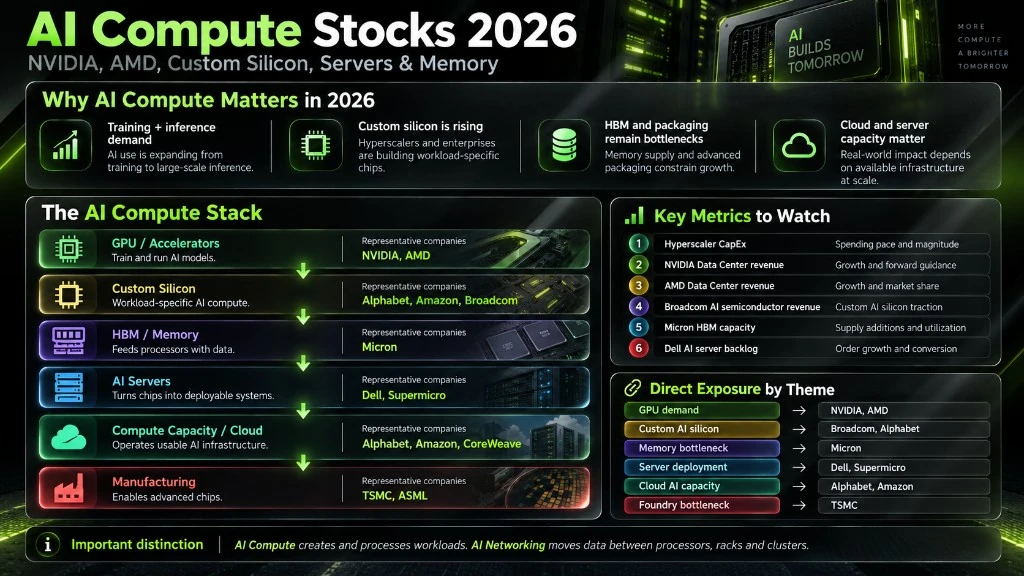
| Compute Layer | What It Does | Representative Stocks | What to Watch | |---|---|---|---| | GPU / Accelerators | Train and run AI models | NVIDIA, AMD | Data Center revenue, accelerator roadmap | | Custom AI Silicon | Optimize specific AI workloads | Alphabet, Amazon, Broadcom | TPU/Trainium deployments, ASIC revenue | | HBM / Memory | Feed processors with high-speed data | Micron | HBM capacity, pricing, margins | | Manufacturing | Produce advanced processors | TSMC, ASML | Advanced-node and packaging capacity | | AI Servers | Turn processors into deployable systems | Dell, Supermicro | AI server orders and backlog | | Compute Capacity | Operate and rent usable AI infrastructure | Alphabet, Amazon, CoreWeave | CapEx, cloud growth, backlog |
This distinction matters because two companies can both benefit from AI spending while having very different economics.
NVIDIA benefits when customers need more accelerators. Micron benefits when those accelerators require more high-bandwidth memory. Dell benefits when customers turn chips into full server systems. Google and Amazon can benefit both as builders of custom silicon and as operators of the cloud capacity where those chips are deployed.
That is why “AI compute stock” is better understood as an economic exposure than as a single industry classification.
NVIDIA: The Benchmark for AI Accelerator Demand
NVIDIA remains the benchmark for measuring the strength of the AI accelerator cycle.
Its advantage is broader than the GPU itself. NVIDIA combines accelerators, CUDA software, rack-scale systems and an increasingly integrated data-center architecture. That makes Data Center revenue one of the clearest indicators of how aggressively customers are still building AI infrastructure.
In fiscal Q2 2027, NVIDIA generated $96.2 billion in total quarterly revenue, while Data Center revenue reached $89.0 billion. Data Center sales increased 18% sequentially and 117% year over year. The company guided to approximately $108 billion of total revenue for the following quarter.
For investors tracking NVIDIA as an AI compute exposure, the important questions are therefore not simply whether AI demand is “strong.”
The better questions are whether Data Center growth continues, whether new platforms such as Vera Rubin ramp without major execution problems, whether hyperscaler spending remains elevated, and whether gross margins hold as infrastructure becomes more complex.
The main risk is also clear: expectations are already high. Slower hyperscaler CapEx, stronger custom silicon adoption, export restrictions or valuation compression could affect the stock even if AI infrastructure continues growing.
AMD: A Different Route Into AI Compute
AMD represents a different compute exposure.
The company competes in accelerators through its Instinct portfolio, but it also participates in the data center through EPYC CPUs. This gives AMD exposure to both accelerated AI workloads and the broader server-compute environment surrounding them.
For the quarter ended June 27, 2026, AMD reported Data Center revenue of $6.7 billion, up 107% year over year. The company attributed the increase primarily to strong demand for EPYC processors and Instinct MI350 Series GPUs.
That makes the NVIDIA-versus-AMD comparison more nuanced than simply asking which GPU is faster.
NVIDIA currently has the more established accelerator ecosystem. AMD's thesis depends on whether customers increasingly want alternative accelerator suppliers, whether Instinct adoption continues scaling and whether the company's CPU position helps it capture a larger share of AI infrastructure spending.
For investors, the most useful indicators are Data Center revenue growth, Instinct deployment momentum, EPYC demand, software ecosystem progress and large-customer commitments.
Custom Silicon: Google, Amazon and Broadcom Change the Compute Equation
One of the most important developments in the 2026 AI compute market is the growing role of custom silicon.
Hyperscalers do not necessarily want every workload to run on the same processor. When workloads become large and predictable enough, a chip designed around a specific set of tasks can improve performance, power efficiency or cost.
Alphabet: Compute Capacity Becomes a Competitive Advantage
Alphabet is increasingly relevant to the AI compute discussion because Google controls several layers of the stack at once.
It develops TPUs, owns large-scale data-center capacity, operates Google Cloud and uses that infrastructure internally across Gemini, Search and other products.
Alphabet reported Q2 2026 revenue of $119.8 billion, while Google Cloud revenue increased 82% year over year to $24.8 billion. Alphabet also reported $44.9 billion of capital expenditures during the quarter, primarily for technical infrastructure.
The company subsequently raised its 2026 CapEx expectation to roughly $195–205 billion as it accelerated infrastructure expansion.
This helps explain why analyst attention has shifted from Google simply being an “AI software” company toward Google as a compute-capacity owner.
Earlier in 2026, Wells Fargo upgraded Alphabet and highlighted customer data, distribution and compute capacity as three attributes supporting its AI position. The firm's analysis argued that Google's compute capacity could rise materially through 2028.
For the compute thesis, the important question is whether that enormous CapEx base produces proportionate growth in Cloud, AI services and internal monetization.
Amazon: Trainium Meets AWS
Amazon offers a similar but distinct model.
AWS combines third-party accelerators with internally designed silicon such as Trainium and Inferentia. Amazon said earlier this year that Trainium and Graviton had reached a combined annual revenue run rate above $10 billion, while Trainium2 capacity was heavily committed.
In Q2 2026, AWS revenue increased 37% year over year to $42.2 billion.
The investment case therefore sits at the intersection of custom silicon and cloud monetization: Amazon can spend heavily on infrastructure while attempting to reduce the unit economics of AI workloads inside AWS.
Broadcom: Custom Accelerators Without Owning the Cloud
Broadcom provides another way to participate in custom AI compute.
Unlike Google or Amazon, it does not need to operate the end-user cloud platform. Instead, Broadcom works with large customers on custom AI accelerators and associated semiconductor infrastructure.
In fiscal Q3 2026, Broadcom reported $16.7 billion of AI semiconductor revenue, up 221% year over year and 54% sequentially. Management forecast approximately $21.7 billion for the following quarter.
Broadcom is unusual because it does not sit entirely inside Compute. Custom AI accelerators give it exposure to rising processing demand, while switching and high-speed interconnect businesses place it inside the AI networking layer as well, making it one of the companies that spans both sides of the infrastructure buildout.
Micron and HBM: Why Memory Became Part of the Compute Thesis
An accelerator cannot process data faster than the surrounding memory system can supply it.
That is why high-bandwidth memory, or HBM, has moved from a relatively technical semiconductor topic into the center of the AI infrastructure investment debate.
AI models require enormous amounts of data to move between memory and processors. As accelerator performance rises, memory bandwidth becomes increasingly important to overall system performance.
Micron gives US equity investors one of the most direct listed exposures to that layer.
The company said in its latest fiscal Q3 2026 update that HBM4 had entered high-volume shipments for a lead customer's platform, while qualification samples had also been sent to multiple end customers.
The key variables here are different from NVIDIA's.
For Micron, investors should pay closer attention to HBM capacity, pricing, supply agreements, gross margins and the possibility that today's tight memory environment eventually normalizes.
Memory can benefit strongly during a shortage, but the semiconductor memory industry has historically been cyclical. That makes supply discipline almost as important as AI demand.
Dell: AI Servers Turn Chips Into Deployable Compute
Buying an accelerator does not automatically create usable AI capacity.
Processors, memory, networking, storage, cooling and power systems have to be integrated into server and rack-scale infrastructure before customers can deploy them.
That gives Dell a different kind of exposure to the compute buildout.
For fiscal Q2 2027, Dell reported $60.9 billion of AI server orders, $16.4 billion of quarterly AI server revenue and a $95 billion ending AI backlog. The company also raised its full-year AI-optimized server revenue forecast to $74 billion.
Those numbers make AI server backlog an especially useful downstream indicator.
Accelerator revenue tells investors that chips are being sold. Server orders and backlog help show whether customers are translating those chips into full infrastructure deployments.
This layer also makes the AI trade more dependent on execution. Server vendors have to manage complex component supply, thermal design, power density and customer-specific configurations.
Which AI Compute Stocks Offer the Most Direct Exposure?
There is no single definition of “most direct” because each company represents a different bottleneck.
| Investment Thesis | More Direct Exposure | |---|---| | AI GPU demand | NVIDIA, AMD | | Custom AI accelerators | Broadcom, Alphabet | | HBM / memory constraint | Micron | | AI server deployment | Dell, Supermicro | | Cloud compute capacity | Alphabet, Amazon | | Advanced manufacturing | TSMC | | Semiconductor equipment | ASML |
“Most direct” should not be confused with “best stock.”
A company can have very direct AI exposure while trading at an expensive valuation. Another company may have a less pure AI revenue mix but stronger cash generation or lower expectations.
The useful question is therefore:
Which part of the AI compute stack do you actually want exposure to?
What Earnings Metrics Matter Most for AI Compute?
AI enthusiasm is easy to measure in headlines. AI economics are better measured through operating data.
| Signal | What It Tells You | |---|---| | GOOGL / AMZN / MSFT / META CapEx | Upstream infrastructure spending | | NVIDIA Data Center revenue | Accelerator demand | | AMD Data Center revenue | Competitive GPU and CPU demand | | Broadcom AI semiconductor revenue | Custom silicon adoption | | Micron HBM capacity and pricing | Memory bottlenecks | | Dell AI server orders / backlog | Real infrastructure deployment | | Google Cloud / AWS growth | Monetization of installed compute |
Taken together, these numbers create a useful chain:
CapEx → Chips → Memory → Servers → Compute Capacity → Cloud / AI Revenue
If the left side continues growing but monetization on the right side fails to follow, the market may eventually question the return on the infrastructure cycle.
That is one of the most important risks to monitor in 2026.
What Could Break the AI Compute Thesis?
The strongest risk is not necessarily that companies suddenly stop using AI. A more realistic risk is that the economics of infrastructure expansion change.
A slowdown in hyperscaler CapEx could reduce demand throughout the supply chain. Weak AI monetization could make boards and investors more demanding about returns on incremental infrastructure.
Greater adoption of custom silicon could change the economics of merchant GPUs, while easing HBM or packaging constraints could pressure suppliers that benefited from scarcity.
Valuation matters as well. Even when revenue keeps growing, higher interest rates or lower growth expectations can compress technology multiples.
Export controls and geopolitical restrictions add another layer because the AI semiconductor supply chain remains globally distributed.
The result is an important distinction:
A strong long-term AI theme does not guarantee every AI compute stock will perform well at every valuation.
AI Compute vs AI Networking: What Is the Difference?
AI Compute and AI Networking are closely related, but they solve different problems.
Compute creates and processes AI workloads. GPUs, custom accelerators, memory and servers sit primarily in this layer.
Networking moves data between processors, racks, clusters and data centers.
| AI Compute | AI Networking | |---|---| | NVIDIA | Credo | | AMD | Ciena | | Micron | Lumentum | | Dell | Coherent | | Google TPU | Broadcom networking |
Broadcom spans both categories because it participates in custom AI silicon as well as networking.
The distinction matters because stronger AI demand can benefit both layers without producing the same revenue drivers. Compute is primarily about creating processing capacity; networking is about moving enough data through that capacity efficiently.
How AI Compute Exposure Works on MSX
Before trading an AI-related stock theme, the first step is not choosing NVIDIA versus AMD. It is confirming what product you are actually trading.
Two products can track the same company while giving users very different legal and economic exposure. For example, tokenized stocks and traditional shares should not automatically be treated as equivalent because ownership rights, custody, dividends and the handling of corporate actions may differ.
A stock-linked perpetual contract is different again. Leverage, funding, margin and liquidation can become part of the return profile even when the underlying reference is the same NVIDIA or Alphabet share price.
For users accessing equity themes through a crypto account, the tokenized-stock product structure therefore matters before the company thesis itself: the instrument determines what rights the user has, what holding costs may apply and how the position can be exited.
A simple pre-trade framework is:
| Question | Why It Matters | |---|---| | Which compute layer am I buying? | GPU, ASIC, memory and server companies have different drivers | | How much revenue is actually AI-linked? | “AI exposure” can be broader than reported AI revenue | | Is growth based on revenue or guidance? | Guidance carries more uncertainty | | Is hyperscaler CapEx still expanding? | It funds much of the infrastructure cycle | | Is supply still constrained? | Scarcity can influence pricing and margins | | What valuation is already priced in? | Good businesses can still become expensive stocks | | What product am I trading? | Ownership and contract exposure are not the same | | Does leverage or funding apply? | It changes downside and holding costs |
What to Read Next
AI compute is one part of a wider infrastructure stack. The AI Networking Stocks 2026 guide focuses on the interconnect, switching and optical systems that move data through AI clusters, while AI Cybersecurity Stocks 2026 looks at the security layer around increasingly production-critical AI infrastructure.
For a more time-sensitive view of the same investment cycle, the Broadcom and Dell AI demand review shows how strong semiconductor and server demand can coexist with valuation pressure from higher Treasury yields.
Final Takeaway
The AI compute trade in 2026 has expanded beyond a single-chip story.
NVIDIA still provides the clearest benchmark for accelerator demand, but AMD represents growing alternative compute exposure. Google and Amazon show how hyperscalers are combining proprietary silicon with massive data-center capacity. Broadcom captures custom accelerator demand, Micron represents the memory bottleneck, and Dell shows how semiconductor spending eventually becomes deployable infrastructure.
That makes the more useful investment framework:
GPU → Custom Silicon → Memory → Servers → Compute Capacity
rather than simply asking which company is “the best AI stock.”
The next phase of the AI infrastructure cycle will depend not only on how much compute companies can build, but also on whether that capacity produces enough revenue and productivity to justify the capital required to keep scaling it.
Official Resources
Financial figures and operational data in this article are based primarily on the latest available company filings, earnings releases and investor-relations materials from NVIDIA, AMD, Alphabet, Broadcom, Micron, Amazon and Dell as of September 10, 2026.
Full Disclaimer: This material is for educational and informational purposes only. It does not constitute investment, legal, tax or financial advice, or a recommendation to buy or sell any security or financial product. AI infrastructure companies can be volatile, and historical operating growth does not guarantee future investment returns. Product availability, trading rules and regional eligibility may change. Verify current information before making any financial decision.