AI Networking Stocks 2026: Broadcom, Credo, Ciena & the Optical Connectivity Trade
Quick Answer
AI infrastructure spending is moving beyond a simple question of how many GPUs hyperscalers can deploy. As AI clusters grow, another constraint becomes increasingly important: how quickly and efficiently those processors can exchange data.
For the adjacent AI compute layer (NVIDIA, AMD, HBM, servers), see AI Compute Stocks 2026.
For the adjacent AI cybersecurity layer (CRWD, PANW, ZS, OKTA, NET), see AI Cybersecurity Stocks 2026.
That shift brings networking silicon, high-speed interconnects, optical systems and photonic components deeper into the AI investment cycle. Broadcom sits across custom AI accelerators and networking silicon. Credo provides high-speed connectivity inside data-center architectures. Ciena focuses further into optical networking and data-center interconnect, while Lumentum and Coherent supply optical technologies that help move increasingly large volumes of data.
Recent earnings support the idea that this spending is broadening. Broadcom reported $16.7 billion of AI semiconductor revenue in its fiscal third quarter, up 221% year over year, and said demand for custom AI accelerators and networking remained very strong. Credo reported quarterly revenue of $479 million, up 114.7% year over year, while Ciena's fiscal third-quarter revenue rose 37% to $1.67 billion.
The question for investors in 2026 is therefore no longer only:
Who sells the most AI compute?
It is also:
Which part of the connectivity stack captures the next round of AI infrastructure spending?
Networking is only one part of the broader AI infrastructure trade. The same framework is mapped out in the AI US Stock Themes 2026 guide, where Compute, Networking and Cybersecurity are treated as distinct but increasingly connected sources of AI-related spending.
What You'll Learn
This guide explains:
- why networking is becoming a larger part of the AI infrastructure trade;
- where Broadcom, Credo, Ciena, Lumentum, Coherent and Fabrinet sit in the networking stack;
- what Broadcom's September earnings say about AI networking demand;
- how Credo differs from a diversified company such as Broadcom;
- why AI demand is reaching Ciena's optical-networking business;
- what actually matters when researching a Lumentum stock forecast;
- how Lumentum and Coherent differ within AI optical interconnects;
- how Fabrinet provides manufacturing exposure to the optical cycle;
- what could break the AI networking thesis;
- how to evaluate AI networking exposure through MSX stock-linked products.
> Disclaimer: This article is for informational and educational purposes only and does not constitute investment advice. Stocks and stock-linked products can lose value, while derivatives may also involve leverage, funding costs and liquidation risk. A full disclaimer appears at the end.
Why AI Networking Is Becoming a Bigger Part of the AI Trade
The first phase of the generative-AI investment cycle focused heavily on compute.
More model training required more GPUs. Larger inference workloads required more accelerators and servers. That made semiconductor capacity one of the most visible constraints on AI growth.
But adding processors does not solve every infrastructure problem.
Thousands of GPUs inside a large AI cluster need to exchange model parameters and data continuously. As cluster size increases, the speed, power efficiency and latency of those connections become increasingly important.
The infrastructure chain starts to look more like:
GPU / Accelerator → High-Speed Interconnect → Switching → Optical Connectivity → Data-Center Interconnect
This is why AI networking is becoming a distinct investment theme rather than simply a subcategory of the semiconductor trade.
Inside a cluster, high-speed electrical and optical connections move data among processors, servers and switches. Between clusters, campuses and data centers, optical networking carries traffic across longer distances.
Coherent describes the same structural shift from a technology perspective: as AI workloads scale, optical connectivity is becoming increasingly important because data-center architectures must move much larger volumes of data with better bandwidth and energy efficiency. Its 2026 product roadmap includes 1.6T and 3.2T transceivers, co-packaged optics and other architectures designed for AI-scale networks.
That makes the AI networking thesis broader than any single stock.
!AI networking stocks 2026 stack showing Broadcom, Credo, Ciena, Lumentum, Coherent and Fabrinet
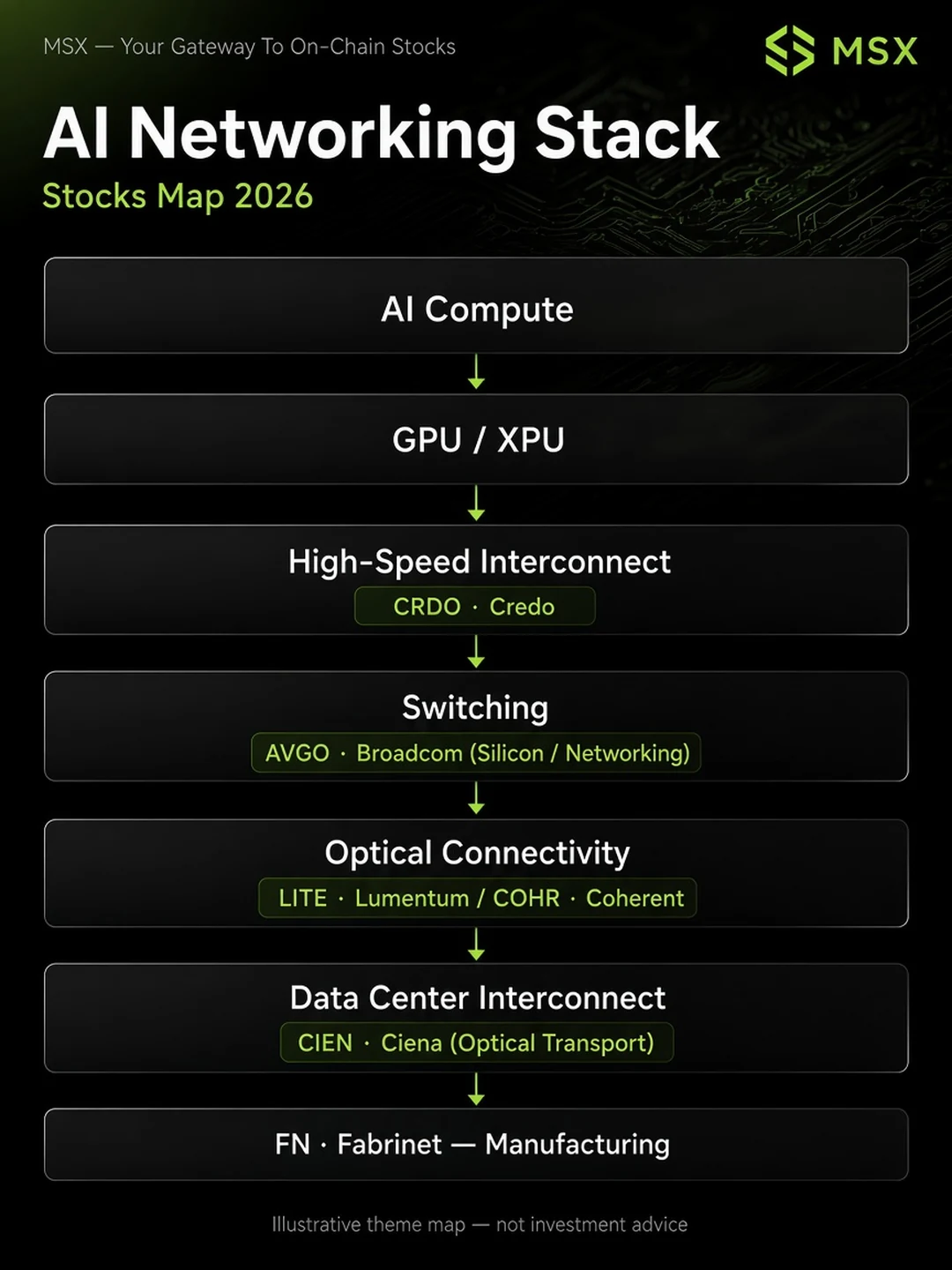
The AI Networking Stack: Where AVGO, CRDO, CIEN, LITE, COHR and FN Fit
The companies often grouped under "AI networking" do not sell the same products.
| Company | Main Layer | Role in the AI Networking Theme | Key Variable | |---|---|---|---| | Broadcom (AVGO) | AI silicon / networking | Custom AI accelerators and networking silicon | Hyperscaler AI spending | | Credo (CRDO) | High-speed connectivity | Interconnect solutions for data-center networks | Network density and customer ramps | | Ciena (CIEN) | Optical networking systems | DCI and high-capacity optical transport | AI-driven network upgrades | | Lumentum (LITE) | Optical components | Lasers and optical connectivity products | Optical demand and capacity | | Coherent (COHR) | Photonics / optical systems | Transceivers, lasers, CPO and optical platforms | AI optical adoption and manufacturing scale | | Fabrinet (FN) | Manufacturing | Precision manufacturing for optical and data-center products | Customer volume and manufacturing leverage |
This distinction matters.
Someone bullish on AI networking does not necessarily have the same thesis when buying AVGO, CRDO or CIEN. Broadcom combines AI networking with a much larger semiconductor and software portfolio. Credo offers more concentrated connectivity exposure. Ciena sits further into the network-system layer, while Lumentum and Coherent are closer to the optical component and photonics cycle.
The narrower the exposure becomes, the more company-specific execution, customers and product cycles can matter.
Broadcom After Earnings: Is AI Networking Demand Still Accelerating?
Broadcom remains one of the clearest links between AI compute and AI networking because the company participates in both custom accelerators and the infrastructure connecting large AI systems.
Broadcom Earnings Date and Latest Results
Broadcom reported its fiscal third-quarter 2026 results on September 2, 2026.
Revenue reached $29.6 billion, up 86% from the prior-year period. More important for this theme, AI semiconductor revenue reached $16.7 billion, increasing 221% year over year and 54% sequentially. Broadcom said demand for both custom AI accelerators and networking remained very strong and projected AI semiconductor revenue of approximately $21.7 billion for the following quarter.
The numbers matter because Broadcom is not describing AI growth as a pure accelerator story.
Networking is part of the same capacity buildout.
More accelerator deployments increase the need for switches, networking silicon and high-bandwidth connectivity. In that sense, compute growth can create a second-order spending cycle around the network.
What Broadcom Earnings Say About the Networking Thesis
Broadcom's latest results strengthen three parts of the AI networking argument.
First, hyperscaler AI infrastructure spending remains large enough to support rapid semiconductor growth.
Second, the company continues to discuss custom accelerators and networking together, suggesting that connectivity demand is scaling alongside compute rather than being treated as an unrelated market.
Third, its Q4 AI semiconductor outlook indicates that management expects the current infrastructure cycle to continue rather than immediately normalize.
That does not mean AVGO automatically rises with every strong AI quarter. Valuation, customer concentration, expectations and the performance of Broadcom's non-AI businesses still matter.
Is Broadcom Expected to Beat Earnings?
For investors searching "is Broadcom expected to beat earnings," the September report has already moved that question into the past.
Broadcom released Q3 results on September 2. The more useful question now is whether future AI accelerator and networking growth can remain strong enough to support the expectations already embedded in the stock.
In other words, after a strong quarter the benchmark changes.
The question is no longer simply:
Did Broadcom beat?
It becomes:
Can the next quarter justify an even higher AI growth baseline?
Credo: A More Concentrated AI Interconnect Bet
Broadcom is diversified. Credo is a more targeted way to examine high-speed connectivity inside expanding data-center networks.
What Does Credo Technology Do in AI Networking?
Credo positions its business around fast, reliable and energy-efficient connectivity.
As AI systems add more accelerators, traffic between GPUs, servers and switches increases. That puts pressure on the interconnect layer to deliver more bandwidth without allowing power consumption and signal degradation to rise too quickly.
Credo's relevance to the AI networking thesis comes from this layer of the architecture.
The company is therefore less a bet on the amount of raw compute installed and more a bet on the connectivity required to make large clusters work efficiently.
As AI networks move from 400G and 800G toward 1.6T architectures, that requirement for denser and faster connectivity becomes increasingly important. The same expansion is beginning to show up in product coverage, with MSX adding CRDO and CIEN alongside PANW as AI-related stock-linked markets broaden beyond pure compute exposure.
Credo Technology Earnings Date and Latest Results
Credo reported its fiscal first-quarter 2027 results on September 1, 2026.
Revenue was $479 million, increasing 114.7% year over year and 9.6% sequentially. Non-GAAP gross margin reached 68.0%.
The growth rate reinforces the idea that high-speed connectivity demand is participating in the broader AI infrastructure cycle.
But fast revenue growth also raises the bar for future execution.
Is Credo Technology a Good Stock to Buy?
There is no universal yes-or-no answer to whether Credo Technology is a good stock to buy.
A more useful question is whether CRDO matches the specific AI networking thesis being researched.
The bull case centers on:
- higher network density inside AI clusters;
- continued upgrades in high-speed connectivity;
- strong data-center demand;
- revenue growth that is more concentrated on connectivity than at larger diversified peers.
The risk case includes:
- customer concentration;
- elevated growth expectations;
- competition;
- sensitivity to hyperscaler capital spending;
- valuation risk if revenue growth slows.
CRDO may offer more direct networking exposure than Broadcom, but that concentration works in both directions. Strong demand can produce higher operating sensitivity, while any customer or spending slowdown can have a larger impact.
Ciena: Why AI Demand Is Reaching Optical Networks
Credo is closer to connectivity inside data-center architecture. Ciena sits further down the networking chain, where enormous amounts of data must move between facilities, campuses and regions.
The Ciena Optical Networking AI Demand Thesis
Ciena's fiscal third-quarter 2026 revenue reached $1.67 billion, up 37% year over year. The company also raised its full-year revenue outlook to approximately $6.42 billion at the midpoint. CEO Gary Smith directly linked the company's performance to AI driving additional waves of network investment.
The underlying logic is relatively straightforward.
Larger AI infrastructure does not exist inside a single server rack.
AI workloads increasingly require data to travel:
within clusters → between data-center buildings → across campuses → between data centers
That creates demand for data-center interconnect and high-capacity optical transport.
Ciena therefore represents a different part of the AI networking trade from CRDO. Credo is more closely associated with high-speed interconnect around compute clusters, while Ciena provides exposure to the network systems needed to transport data across larger infrastructure footprints.
Is Ciena a Good Stock to Buy?
The question "is Ciena a good stock to buy?" is better treated as a thesis test than as a recommendation.
The case for CIEN becomes stronger if an investor expects:
- AI data-center capacity to keep expanding geographically;
- DCI traffic to rise;
- carriers and cloud providers to upgrade optical networks;
- AI infrastructure spending to extend beyond chips into transport systems.
The risks are different from those at a pure semiconductor company.
Ciena remains exposed to customer spending cycles, carrier investment, execution and the timing of large network deployments. Strong AI demand does not eliminate those variables.
So CIEN can fit an AI networking thesis without being interchangeable with CRDO or AVGO.
Lumentum, Coherent and the Optical Interconnect Layer
As AI clusters require more bandwidth, the conversation increasingly moves from electrical links toward optical technologies.
Lumentum and Coherent sit inside this transition.
Why Lumentum Matters to AI Networking
Lumentum reported fiscal fourth-quarter 2026 revenue of $1.01 billion and guided the following quarter to $1.225 billion–$1.275 billion.
Management described the current market as a structural shift in which growing AI compute workloads are pushing data-center architects toward optical links as a primary connectivity technology.
This makes Lumentum relevant not because it sells GPUs, but because larger AI systems require increasingly capable optical infrastructure around those processors.
Lumentum Stock Forecast: What Actually Drives the Outlook?
A useful Lumentum stock forecast should not start with an arbitrary price target.
The operating outlook depends more directly on four questions:
- Does AI optical demand continue to accelerate?
- Can Lumentum add capacity fast enough to serve that demand?
- Do hyperscaler capital budgets remain strong?
- Can higher volumes translate into sustainable margin expansion?
If those variables improve, the fundamental outlook can strengthen. If customers delay deployments or optical capacity moves ahead of end demand, expectations can move in the opposite direction.
That framework is more useful than pretending a precise future share price can be known.
Lumentum vs Coherent for AI Optical Interconnect
Lumentum and Coherent both offer exposure to the optical transition, but their portfolios are not identical.
| Area | Lumentum | Coherent | |---|---|---| | Core AI angle | Optical connectivity and photonics | Broad photonics and optical networking stack | | Product exposure | Optical components and connectivity | Lasers, transceivers, CPO, optical systems | | Key catalyst | AI optical demand and production ramps | AI optical adoption plus manufacturing scale | | Key risk | Capacity, customer demand, margins | Execution across a broader product portfolio |
Coherent reported Q4 FY2026 revenue of $2.05 billion, up 34% year over year, and said AI data-center architectures are increasingly moving from copper toward optical connectivity. It has also demonstrated 1.6T and 3.2T transceivers and multiple co-packaged-optics technologies aimed at AI-scale infrastructure.
The comparison is therefore less about choosing a single "AI optics winner" and more about understanding where each company's portfolio sits within the optical transition.
Where Does Fabrinet Fit in the AI Optical Chain?
Fabrinet is different from Broadcom, Credo, Ciena, Lumentum or Coherent because it sits closer to the manufacturing layer.
The company provides advanced optical packaging and precision manufacturing for technology OEMs.
In fiscal 2026, Fabrinet generated $4.64 billion of revenue, up 35.7% year over year. Data-center products accounted for 47.9% of annual revenue, according to its 10-K. Its fourth-quarter revenue reached a record $1.316 billion, up 45% year over year.
This creates a different kind of Fabrinet AI optical manufacturing leverage.
If customers need to ramp optical and data-center hardware volumes, a manufacturing partner can benefit from that production expansion without necessarily owning the underlying optical architecture.
But that exposure comes with its own risks:
- customer concentration;
- contract-manufacturing economics;
- customers' product cycles;
- manufacturing execution;
- capacity utilization.
Fabrinet is therefore a manufacturing expression of the AI optical cycle rather than a direct substitute for a networking-silicon or optical-system company.
Which AI Networking Exposure Is the Most Direct?
"AI networking stock" is a broad label.
The more useful approach is to match the company to the thesis.
| If the thesis is... | Exposure more closely aligned with it | |---|---| | Custom AI silicon plus large-scale networking | AVGO | | High-speed connectivity around AI clusters | CRDO | | Optical networks and data-center interconnect | CIEN | | Optical-component demand | LITE / COHR | | Manufacturing volume from optical and data-center products | FN |
There is an important trade-off here:
More direct thematic exposure can also mean more concentration risk.
Broadcom has more businesses outside the narrow networking theme. Credo has more focused connectivity exposure. Fabrinet depends heavily on customer production volumes rather than on owning the core architecture.
The "best" exposure therefore depends on what part of the AI networking thesis an investor actually wants to test.
What Could Break the AI Networking Thesis?
The networking story is strong enough that it is easy to write the entire sector as a bullish narrative.
That would miss the most important risks.
1. Hyperscaler CapEx Slows
Much of the current theme ultimately depends on large cloud and technology companies continuing to build AI infrastructure.
If capital spending slows, demand can move through the supply chain quickly.
2. Capacity Is Built Ahead of Demand
Fast growth encourages suppliers to expand capacity.
If networking or optical capacity grows faster than actual deployment, utilization, pricing and margins can come under pressure.
3. Customer Concentration Remains High
Some networking companies depend heavily on a small number of hyperscale customers.
Losing a design win, delaying a ramp or seeing one customer reduce spending can materially change the growth outlook.
4. The Optical Transition Takes Longer Than Expected
The long-term bandwidth problem may be real while individual technology transitions still move more slowly than expected.
Copper, pluggable optics, co-packaged optics and other architectures can coexist for extended periods.
5. Valuation Runs Ahead of Fundamentals
A company can deliver excellent earnings and still have a weak stock reaction if expectations were even higher.
This is why:
Theme right ≠ stock right.
And for users trading stock-linked products:
Stock right ≠ product right.
How to Trade AI Networking Exposure on MSX
Once the networking thesis is defined, the next decision is how to express it.
For networking specifically, the process can be reduced to five checks.
Step 1: Build the Theme Shortlist
A networking watchlist might include:
- AVGO
- CRDO
- CIEN
- LITE
- COHR
- FN
The list is a research starting point, not a claim that every ticker is available on MSX at all times.
Step 2: Check Which Products Are Actually Available
MSX listed PANW, CRDO and CIEN US stock token contracts on August 31, extending its AI-related product coverage into high-speed interconnect and optical networking. Those additions form part of a broader expansion in equity-linked markets discussed in the 2026 tokenized-stocks market update.
Current availability should still be checked on the live platform because listings and regional access can change.
Step 3: Confirm the Product Type
A familiar ticker does not necessarily mean the product works like a share held in a brokerage account.
MSX's RWA architecture can include both spot-style markets and perpetual-style products, so ownership, leverage, funding and corporate-action treatment may differ. The broader product structure is explained in the Tokenized Stocks Guide 2026, while the comparison between tokenized stocks and traditional stocks focuses more directly on ownership rights, dividends and market structure.
Step 4: Check Liquidity and Trading Costs
Before entering a position, review:
- bid-ask spread;
- order-book depth;
- leverage;
- funding rates;
- trading hours;
- exit mechanics.
A strong company thesis cannot compensate for poor execution in an illiquid product.
Step 5: Match the Product to the Investment Horizon
Suppose the thesis is that AI networking infrastructure will expand over the next three to six months.
Using a highly leveraged contract to express that longer-duration idea can introduce a mismatch between the research horizon and the trading instrument.
Funding costs, liquidation risk and short-term volatility can end the position before the underlying industry thesis has time to play out.
The practical rule is:
Choose the theme first, then the company, then the product.
AI Networking Checklist
Before trading an AI networking name, ask:
- Where does the company sit in the AI networking stack?
- Is demand tied mainly to scale-up, scale-out or data-center interconnect?
- How much of recent growth actually comes from AI-related demand?
- How concentrated is the customer base?
- Does the current valuation already assume continued rapid growth?
- What does the latest earnings guidance say about the next phase of demand?
- Am I buying a share-like spot product or a derivative contract?
- What development would invalidate the original thesis?
A ticker should come after those questions, not before them.
Final Takeaway
The 2026 AI infrastructure trade is moving from a simple focus on compute toward a broader question:
How do we connect all of that compute?
Networking is also only one branch of the broader rotation within the AI trade. Capital has increasingly moved beyond pure compute into adjacent infrastructure themes, including the expansion of the AI trade into cybersecurity names such as CRWD and NET.
Broadcom captures custom AI accelerators and networking at scale. Credo offers more concentrated exposure to high-speed connectivity. Ciena represents the optical network and DCI layer. Lumentum and Coherent sit inside the growing optical-interconnect requirement, while Fabrinet provides manufacturing exposure to rising data-center hardware volumes.
Recent results across several of these companies support the view that networking and optics are participating in the AI capital-spending cycle. But the stocks are not interchangeable, and strong industry demand does not remove valuation, concentration or execution risk.
A more durable research sequence is:
AI Demand → Networking Layer → Company → Earnings Evidence → Valuation & Risk → Trading Product
For users accessing the theme through tokenized or contract-based markets, one final step remains essential:
Verify what product is actually behind the ticker before placing the trade.
Full Disclaimer
This article is provided for informational and educational purposes only. It does not constitute investment advice, financial advice, legal advice or tax advice, and it is not an offer to sell or a solicitation to purchase any security, derivative or other financial product.
Stocks discussed in this article may experience substantial price volatility and may be affected by earnings results, valuation changes, customer concentration, competitive conditions, capital-spending cycles, interest rates and broader market conditions.
Stock-linked RWA products, tokenized instruments and derivatives may carry additional risks, including tracking differences, liquidity risk, counterparty risk, leverage, funding costs, margin requirements and liquidation. A product that references a public-company ticker does not necessarily provide the same ownership rights, custody arrangements, dividends or corporate-action treatment as shares held through a traditional brokerage account.
Product availability, market structure, supported assets, leverage, fees, funding rates, trading hours and regional eligibility on MSX may change over time. Any ticker or product mentioned in this article is used as an example and should not be interpreted as continuously available in every jurisdiction.
Before making any investment or trading decision, users should review the latest company filings, product terms, platform disclosures and applicable risk information.