Tokenized Stocks vs Stock Perpetuals 2026: Ownership, Leverage, Fees & Risk
Quick Answer
Tokenized stocks and stock perpetuals can both provide price exposure to the same listed company, but they are not the same product.
A tokenized stock may use a token, custody arrangement, issuer claim or another equity-linked structure to provide exposure to a listed share. A stock perpetual, by contrast, is a derivative contract designed to track the price of a stock without requiring the trader to own that underlying share.
The distinction matters because the two products can behave very differently when it comes to ownership, dividends, leverage, funding, liquidation and exit mechanics.
Within the broader tokenized-stocks framework, the product structure should be checked before the ticker itself. Two instruments referencing the same company can create very different legal and economic exposure.
| Key Question | Tokenized Stock | Stock Perpetual | |---|---|---| | Product type | Tokenized or equity-linked instrument | Derivative contract | | Underlying ownership | Depends on structure | No ownership of underlying share | | Leverage | Product-dependent | Commonly available | | Funding rate | Usually no perpetual funding mechanism | Often applies | | Liquidation | Usually no perpetual-style margin liquidation if unleveraged | Leveraged positions may be liquidated | | Dividends | Depends on product terms | Not the same as shareholder dividends | | Corporate actions | Depends on issuer/platform rules | Handled through contract rules or adjustments | | Long / short | Product-dependent | Usually both available | | Main structural risk | Issuer, custody and legal structure | Leverage, funding, liquidation and basis risk |
> Risk note: Product terms vary across jurisdictions, issuers and trading venues. “Tokenized stock” is not a single globally standardized legal structure. Always verify the actual product documentation before assuming ownership rights, dividend treatment or transferability.
What Is a Tokenized Stock?
A tokenized stock is a digital instrument designed to provide exposure to the price or economics of a listed company's shares.
The important word is exposure.
The label does not automatically tell investors what they legally own.
Depending on the product, the structure could involve:
- a token backed by shares held through a custodian;
- a contractual claim against an issuer;
- a nominee or intermediary structure;
- a synthetic instrument referencing the stock price;
- another regulated or platform-specific arrangement.
Tokenized stocks are therefore better understood as a product category rather than a single legal model.
They also sit inside the wider world of real-world asset tokenization, where off-chain assets or economic rights are represented through blockchain-based infrastructure.
A simplified backed structure might look like:
``text Investor ↓ Tokenized Instrument ↓ Issuer / Custodian ↓ Underlying Share ``
But another product may look more like:
``text Investor ↓ Token / Contractual Claim ↓ Issuer ↓ Reference to Stock Price ``
These two structures can appear similar on a trading screen while giving the investor different legal rights.
That is why the product name alone is not enough.
What Is a Stock Perpetual?
A stock perpetual is a derivative contract that references the price of a stock and has no fixed expiry date.
The trader does not need to buy the underlying share.
A simplified structure looks like:
``text Trader ↓ Perpetual Contract ↓ Stock Reference Price ``
Rather than:
``text Trader ↓ Underlying Stock ``
Stock perpetuals typically borrow mechanics from crypto perpetual futures.
Depending on the venue, they may include:
- long and short positions;
- margin;
- leverage;
- maintenance-margin requirements;
- funding payments;
- liquidation rules.
The purpose is primarily to create a tradable derivative exposure to the movement of the stock price.
That makes a stock perpetual structurally closer to a derivative than to a share certificate or spot-style equity position.
Tokenized Stocks vs Stock Perpetuals: Key Differences
The easiest way to compare the products is to separate four questions:
What do I own?
How is the position financed?
What ongoing costs apply?
How can the position end?
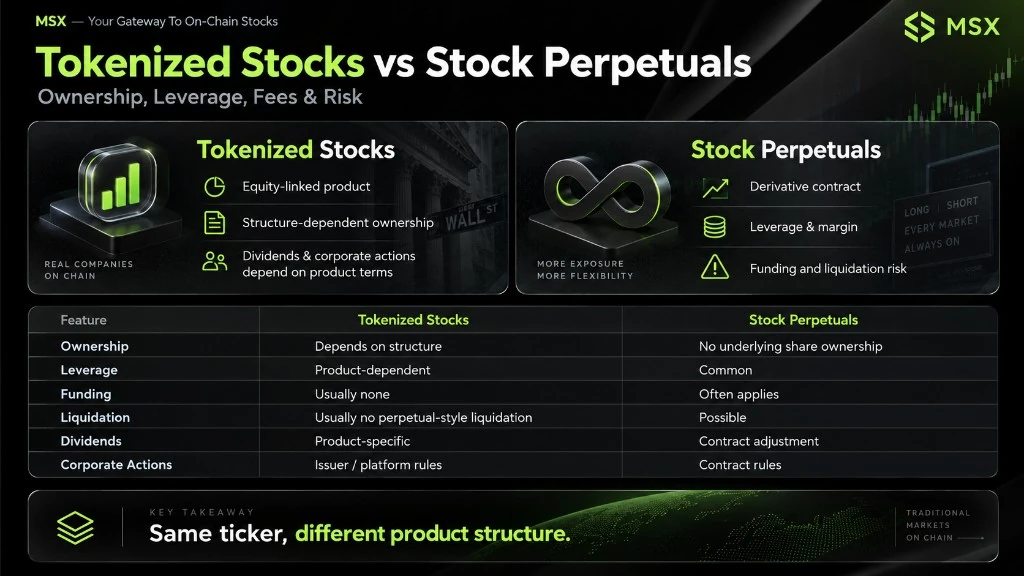
| Dimension | Tokenized Stock | Stock Perpetual | |---|---|---| | Product type | Tokenized / equity-linked instrument | Derivative | | Legal ownership | Depends on issuer structure | No direct ownership of underlying stock | | Underlying backing | May exist, but must be verified | Not required | | Leverage | Depends on product | Common | | Short exposure | Product-dependent | Usually available | | Funding rate | Usually not perpetual funding | Often applies | | Margin | May not be required for unleveraged product | Core part of leveraged trading | | Liquidation | Normally no perpetual-style liquidation if unleveraged | Possible | | Dividend treatment | Product-specific | Contract-specific adjustment | | Corporate actions | Depends on product terms | Governed by contract adjustment rules | | Trading hours | Product-specific | May extend beyond underlying market | | Exit | Sell or redeem depending on structure | Close the derivative position | | Main risk | Issuer, custody, structure, liquidity | Leverage, funding, liquidation, tracking |
Both products may show “NVDA,” “TSLA” or another familiar ticker.
That does not make them economically identical.
What Do You Actually Own?
This is the most important distinction in the entire comparison.
A tokenized-stock structure may create some form of claim linked to the underlying equity.
For example:
``text You ↓ Tokenized Product ↓ Issuer / Custodian Structure ↓ Underlying Share ``
But investors still need to verify:
- who legally owns the underlying share;
- whether the token is redeemable;
- whether the holder is a beneficial owner;
- whether shareholder rights pass through;
- whether assets are segregated;
- what happens if the issuer or custodian fails.
A stock perpetual is different.
``text You ↓ Derivative Contract ↓ Reference Price ``
The trader owns the contract position, not the stock.
The difference becomes clearer when comparing tokenized stocks and traditional shares: following the same company's price does not automatically create the same ownership, custody, dividend or corporate-action rights.
The key principle is simple:
> Same ticker exposure does not mean the same legal or economic rights.
How Does Leverage Change the Risk Profile?
Leverage is one of the clearest structural differences between the two products.
A non-leveraged tokenized-stock position usually behaves more like direct price exposure.
If the referenced stock falls 5%, the position may decline by roughly the same percentage before fees, spreads and tracking differences.
A leveraged perpetual magnifies that movement.
For example:
```text Underlying stock move: -5%
Unleveraged exposure: approximately -5%
5x leveraged perpetual: approximately -25% before funding, fees and other effects ```
This is only an illustrative example.
Actual perpetual P&L depends on entry price, leverage, margin rules, funding, fees and the venue's liquidation mechanism.
The important point is that leverage changes the nature of the position.
A stock perpetual is not simply “a tokenized stock with more trading features.”
Once margin and leverage are introduced, the trader faces a different risk structure.
Funding Rates, Trading Fees and Total Cost
Trading fees are only one part of total cost.
This is especially important when comparing a tokenized stock with a perpetual.
Tokenized-Stock Costs
Possible costs can include:
- trading fees;
- bid-ask spread;
- conversion fees;
- custody or platform charges;
- withdrawal or blockchain network fees;
- redemption-related costs.
Not every product uses all of these fees.
Stock-Perpetual Costs
A perpetual position may involve:
- maker or taker fees;
- bid-ask spread;
- slippage;
- funding payments;
- margin-related capital costs;
- liquidation costs if the position is forcibly closed.
Funding is especially important for positions held over time.
A low headline trading fee does not necessarily mean a low holding cost.
For perpetuals, the total cost of leveraged trading can extend well beyond maker or taker fees because funding, spread, leverage and liquidation risk all affect the economics of the position.
This creates an important distinction:
> A tokenized stock may have higher transaction friction but lower ongoing financing costs, while a perpetual may have low entry fees but accumulate funding and leverage-related costs over time.
The actual result depends on the specific product.
How Are Dividends and Corporate Actions Handled?
This is another area where the ticker symbol can create false confidence.
A tokenized product tracking a dividend-paying stock does not automatically mean the holder receives the same dividend rights as a registered shareholder.
The product may:
- pass through cash distributions;
- credit an economic equivalent;
- adjust the token value;
- handle the event in another way;
- provide no direct shareholder distribution at all.
The treatment must be verified from the product documentation.
The same applies to corporate actions such as:
- stock splits;
- mergers;
- spin-offs;
- rights offerings;
- tender offers.
A stock perpetual is even more clearly separated from shareholder rights.
The trader owns a derivative contract, so dividends and corporate actions are usually reflected through contract rules, price adjustments or cash-equivalent mechanisms rather than direct participation as a shareholder.
This means:
> Price exposure and shareholder rights should be analyzed separately.
Why Do Perpetuals Have Liquidation Risk?
A leveraged perpetual uses margin.
If the position moves against the trader, the margin supporting the position can fall below the venue's maintenance requirement.
A simplified process looks like:
``text Price moves against position ↓ Margin ratio deteriorates ↓ Maintenance threshold is reached ↓ Position may be liquidated ``
This is fundamentally different from simply holding an unleveraged instrument that declines in value.
If an investor holds an unleveraged tokenized-stock product and the referenced share falls 20%, the position may lose roughly 20% in market value, subject to product tracking and fees.
A 5x leveraged perpetual can face a much more severe outcome because the same price move is magnified relative to posted margin.
A non-leveraged tokenized-stock position generally does not use the same perpetual-style margin-liquidation mechanism, although product-specific rules still need to be checked.
That distinction is one of the strongest reasons not to treat the two products as interchangeable.
Trading Hours, Price Tracking and Market Structure
Tokenized stocks and stock perpetuals may trade outside normal U.S. equity-market hours.
That can appear attractive because the underlying stock itself may be closed while the crypto or derivatives venue remains open.
But continuous trading access does not mean continuous underlying-market liquidity.
When the primary stock exchange is closed:
- price discovery may become weaker;
- spreads may widen;
- trading volume may fall;
- reference prices may depend more heavily on models or alternative markets;
- the product may temporarily diverge from the next official stock-market opening price.
This creates what can be thought of as tracking or basis risk.
The same issue can apply to both tokenized stocks and stock perpetuals, although the pricing mechanism may differ.
A 24-hour interface therefore does not remove the underlying market's opening and closing cycle.
What Happens When the Underlying Stock Moves Sharply?
Consider a stock that rises 15% after an earnings announcement.
Tokenized Stock
A tokenized product may:
- rise with the underlying stock;
- trade at a wider spread;
- temporarily show weaker liquidity;
- diverge from the reference price if the underlying market is closed.
The investor's primary concern is usually the accuracy and liquidity of the price exposure.
Stock Perpetual
A stock perpetual can produce additional effects.
For a long position:
- P&L may rise rapidly;
- margin ratio may improve;
- funding may change as positioning becomes crowded.
For a short position:
- losses may accelerate;
- margin pressure may increase;
- the position may approach liquidation.
The same 15% underlying move can therefore produce very different outcomes depending on leverage and position direction.
When Might a Tokenized Stock Fit Better?
A tokenized-stock structure may be more aligned with users who want:
- directional exposure without intentionally using leverage;
- a spot-style holding experience;
- no perpetual funding mechanism;
- simpler sensitivity to the underlying stock price;
- the ability to hold the position without managing maintenance margin.
But this does not mean tokenized stocks are automatically simple or low risk.
Users still need to understand:
- issuer risk;
- custody structure;
- redemption terms;
- trading liquidity;
- legal rights;
- dividend treatment;
- corporate-action rules.
The structure behind the token remains important.
When Might a Stock Perpetual Fit Better?
A stock perpetual may be more aligned with users who specifically need:
- long and short exposure;
- leverage;
- short-term tactical trading;
- capital-efficient directional positioning;
- continuous derivative-style trading.
In exchange, the trader must accept a more complex risk structure involving:
- margin;
- funding;
- liquidation;
- basis risk;
- leverage-amplified losses.
Perpetuals are therefore structurally more complex than an unleveraged spot-style exposure.
The correct comparison is not simply:
> “Which one is better?”
It is:
> Which risk structure matches the purpose of the position?
What Should You Check Before Trading?
Before selecting either product, check these ten questions:
- [ ] What exactly is the instrument?
- [ ] Do I own the underlying share, an issuer claim or only a derivative contract?
- [ ] Who holds the underlying asset, if one exists?
- [ ] Is leverage used?
- [ ] Can the position be liquidated?
- [ ] Does funding apply?
- [ ] How are dividends handled?
- [ ] How are stock splits and other corporate actions handled?
- [ ] What trading hours and reference prices are used?
- [ ] What are the total holding and exit costs?
If the product page does not answer these questions clearly, the ticker symbol alone is not enough information to make the comparison.
How Do These Products Fit Into a Trading Workflow?
A useful workflow starts with the exposure and only then moves to execution.
``text Choose company or market theme ↓ Identify product type ↓ Verify ownership or contract structure ↓ Check leverage and funding ↓ Estimate total holding cost ↓ Understand exit mechanics ↓ Place the trade ``
This order matters because users can otherwise choose the right company but the wrong instrument.
For example, someone who wants long-term, unleveraged exposure may not want to carry perpetual funding and liquidation risk.
Someone who wants to short a stock for a short-term event may find a perpetual structurally more relevant than a long-only tokenized product.
Once the structure has been selected, the operational steps belong to the tokenized-stock trading workflow, where product availability, order execution and platform mechanics can be evaluated separately.
What to Read Next
Once the product structure is clear, the next step is deciding which equity theme or company exposure matters.
The AI Compute Stocks 2026 guide looks at the semiconductor, custom-silicon, memory and AI-server layers behind the current AI infrastructure cycle.
The AI Networking Stocks 2026 guide focuses on the connectivity side of that buildout, including switching, optical interconnects and data-center networking.
These theme guides answer a different question from this article:
> What equity exposure do I want?
This comparison answers the step before execution:
> What type of instrument am I using to get that exposure?
Final Takeaway
Tokenized stocks and stock perpetuals may reference the same company, appear on the same trading platform and move in broadly the same direction.
That does not make them the same investment.
A tokenized stock may introduce issuer, custody and legal-structure questions.
A stock perpetual introduces derivative mechanics such as leverage, funding, margin and liquidation.
So before comparing prices or fees, start with four questions:
What do I actually own?
Is leverage involved?
What does it cost to hold the position?
How does the position end?
Those questions reveal more about the actual risk than the ticker symbol alone.
The simplest rule is:
> Same company. Same price reference. Different product structure. Different risk.
Official Resources & Methodology
When comparing tokenized stocks with stock perpetuals, the most important information should come from the actual product and regulatory documentation.
Useful sources include:
- issuer product terms;
- custody and reserve disclosures;
- exchange contract specifications;
- funding-rate methodology;
- margin and liquidation rules;
- corporate-action policies;
- applicable securities and derivatives regulations;
- official disclosures from the underlying listed company.
This article uses a structural comparison framework and does not assume that every tokenized-stock or stock-perpetual product follows the same legal, custody or fee model.
Full Disclaimer: This material is for educational and informational purposes only and does not constitute investment, legal, tax or financial advice. Tokenized equity products and stock-linked derivatives can involve issuer, custody, liquidity, leverage, funding, tracking and regulatory risks. Leveraged derivatives can result in rapid losses and liquidation. Product availability and legal treatment vary by jurisdiction and platform. Always review the relevant product documentation before trading.